Financing Options for Outdoor Structures: A 2026 Guide
Copy Link
Table of Contents
- Understanding Your Financing Options for Outdoor Structures
- Rent-to-Own Sheds and Outdoor Structures
- Home Improvement Loans for Outdoor Projects
- Shed Financing with No Credit Check Required
- HELOC for Outdoor Renovations and Additions
- Personal Loans vs. Specialized Outdoor Structure Financing
- How to Apply for Financing: Step-by-Step Process
- Evaluating Total Cost of Ownership Before You Commit
Financing Options for Outdoor Structures: A 2026 Guide
Last Updated: July 26, 2026
When it comes to adding a new shed, gazebo, or pergola to your backyard, the upfront cost can feel overwhelming. That’s where financing options for outdoor structures become essential. At Riehl Structures, we’ve helped hundreds of homeowners turn their backyard dreams into reality by offering flexible payment solutions that fit their budget. Whether you’re looking to build now and pay later, spread payments across several years, or explore home equity options, understanding your financing choices makes the difference between a project that stays on the wishlist and one that transforms your outdoor space.
Understanding Your Financing Options for Outdoor Structures
When you start researching how to pay for an outdoor structure, you’ll encounter several distinct financing vehicles. Each has different approval requirements, interest rates, repayment terms, and total costs. The key is matching the right option to your specific situation, your credit score, available down payment, home equity, and preferred monthly payment amount.
Why Financing Makes Sense for Backyard Projects
Financing an outdoor structure often makes more financial sense than waiting to save cash. When you finance through a dedicated outdoor structure lender, you’re typically looking at fixed monthly payments spread over 3-10 years, which allows you to enjoy the structure immediately while it potentially increases your home’s value. A shed financed at 8% APR over five years costs more in interest than paying cash upfront, but that same shed might appreciate your property value by 5-15%, depending on your market.
Before comparing financing options, calculate your total cost of ownership for each. This means taking the purchase price, adding all interest and fees over the loan term, then comparing that number against the expected increase in home value.
Key Financing Terms You Need to Know
Understanding lending terminology helps you compare offers accurately. APR (Annual Percentage Rate) is the yearly cost of borrowing, expressed as a percentage, including both interest and fees. Loan term refers to how long you have to repay, typically 3, 5, 7, or 10 years for outdoor structures. Monthly payment is the fixed amount you pay each month. Down payment is the cash you put toward the purchase upfront.
A fixed-rate loan means your interest rate and monthly payment never change over the life of the loan. A same-as-cash or deferred interest financing option lets you pay nothing for a set period (often 12 months), then the full remaining balance plus accumulated interest becomes due. Rent-to-own programs let you make monthly payments for a set period, after which you own the structure outright.
Rent-to-Own Sheds and Outdoor Structures
Rent-to-own has become increasingly popular for outdoor structures because it removes the credit check barrier and requires no home equity. You’re essentially leasing the structure with the option to purchase it at the end of the rental period.
How Rent-to-Own Works
With a rent-to-own program, you make monthly payments for a predetermined period, usually 24 to 60 months. A portion of each payment goes toward the eventual purchase price. At the end of the rental period, you own the structure outright. You handle maintenance and repairs during the rental period, and the structure is yours to use however you want. The approval process is typically faster than traditional financing, often requiring only a basic credit check or sometimes none at all.
Rent-to-own structures cost significantly more over time than traditional financing. If you stop making payments before the end of the rental period, you lose all the money you’ve paid in and have no equity to show for it. Make sure you’re committed to completing the full payment term before choosing this option.
Rent-to-Own vs. Traditional Loans: Total Cost of Ownership
Let’s say you’re financing a $12,000 shed. With a rent-to-own program at $350 per month for 48 months, you’ll pay $16,800 total, a $4,800 premium over the purchase price. With a traditional 5-year fixed loan at 9% APR, you’d pay approximately $13,200 total, or $2,200 in interest. The rent-to-own option costs nearly double the interest. However, if your credit score is below 620 or you don’t qualify for a traditional loan, rent-to-own might be your only option. At Riehl Structures, we offer rent-to-own financing with no prepayment penalties, which means you can pay off your structure early without additional fees if your financial situation improves.
Home Improvement Loans for Outdoor Projects
Home improvement loans are specifically designed for residential property upgrades, including outdoor structures. These loans typically come from banks, credit unions, or online lenders. They’re unsecured (meaning you don’t pledge your home as collateral), which makes approval faster but usually results in higher interest rates than a HELOC.
Fixed-Rate Loans and APR Ranges
A fixed-rate home improvement loan locks in your interest rate and monthly payment for the entire loan term. Fixed-rate loans typically range from 3 to 10 years, with APR ranges varying based on your credit score and the lender. For borrowers with excellent credit (750+), fixed-rate home improvement loans typically range from 6% to 8% APR. For those with good credit (700-749), expect 8% to 11% APR. Fair credit (650-699) usually means 12% to 15% APR. Poor credit (below 650) might see 16% to 24% APR or may not qualify at all through traditional lenders.
Same-As-Cash and Deferred Interest Options
Same-as-cash financing lets you make no payments for a promotional period, often 12 or 24 months, then the full remaining balance plus accumulated interest becomes due. If you pay off the balance before the promotional period ends, you owe zero interest. This option works well if you’re confident you can pay off the structure within the promotional window. A $12,000 structure financed at 18% APR for 12 months accrues $2,160 in interest if you don’t pay it off before the period ends.
Same-as-cash financing is only a good deal if you have a concrete plan to pay off the balance before the promotional period ends. If there’s any uncertainty about your ability to pay, choose a fixed-rate loan instead.
Shed Financing with No Credit Check Required
Some financing programs specifically target borrowers who don’t have strong credit or prefer not to undergo a credit check.
Build Now, Pay Later Programs
"Buy now, pay later" (BNPL) services like Affirm have expanded into outdoor structures and home improvement categories. These programs typically offer 3, 6, or 12-month payment plans with no interest if you pay on time. They use alternative credit data and soft credit checks that don’t impact your credit score. The approval process is usually instant or within 24 hours, with monthly payments automatically deducted from your bank account. If you miss a payment, late fees apply and your credit report may be affected.
Credit Score Impact and Approval Process
When you apply for financing, lenders check your credit to assess risk. A hard inquiry temporarily lowers your credit score by 5-10 points. Multiple hard inquiries within 45 days typically count as a single inquiry, so shopping around for the best rate doesn’t hurt as much as you might think. Approval decisions depend on your credit score, debt-to-income ratio (how much you already owe relative to your income), employment history, and the loan amount. For outdoor structures, most lenders require a minimum credit score of 620 and a debt-to-income ratio below 43%. Most lenders provide a decision within 1-3 business days.
HELOC for Outdoor Renovations and Additions
A home equity line of credit (HELOC) is a revolving credit line secured by your home’s equity. You can borrow up to a certain limit, pay it back, and borrow again, similar to a credit card. HELOCs typically have lower interest rates than unsecured loans because your home secures the debt.
How HELOCs Compare to Other Financing Methods
HELOCs offer flexibility that other financing options don’t. You only pay interest on the amount you actually borrow, not the full credit limit. If you’re approved for a $50,000 HELOC but only borrow $12,000 for your outdoor structure, you only pay interest on that $12,000. Interest rates on HELOCs are typically variable, meaning they fluctuate with the prime rate. This makes them cheaper than fixed-rate loans when rates are low, but riskier if rates rise. Many HELOCs have a draw period (usually 10 years) when you can borrow, followed by a repayment period (usually 20 years) when you can only make payments.
The approval process for a HELOC is more involved than other financing options. Lenders require a home appraisal to determine your equity, which costs $300-500. You’ll need to provide tax returns, recent pay stubs, and bank statements. The process typically takes 2-4 weeks. You need sufficient home equity (typically at least 15-20% of your home’s value) and a decent credit score (usually 650+).
HELOCs make sense if you have substantial home equity, plan to make multiple home improvements over time, and can tolerate interest rate fluctuations. If you only need to finance one outdoor structure and want payment predictability, a fixed-rate loan is usually simpler.
Impact on Home Equity and Resale Value
Using a HELOC to finance an outdoor structure reduces your home equity temporarily as you borrow against it. As you pay back the HELOC, your equity increases again. Research suggests that outdoor living spaces increase home values, though the return varies by region and structure type. A well-maintained deck or gazebo typically returns 50-80% of its cost at resale, while a high-quality shed might return 40-60%. The HELOC interest you pay is tax-deductible if you itemize deductions on your taxes, which provides some financial offset.
Personal Loans vs. Specialized Outdoor Structure Financing
Personal loans are unsecured loans from banks, credit unions, or online lenders. They’re not specifically designed for outdoor structures, you can use them for any purpose. Specialized outdoor structure financing comes from dealers, manufacturers, or lenders who specifically work with outdoor structure companies.
Comparing Interest Rates and Flexibility
Personal loans typically range from 5% to 36% APR, depending on your credit score and lender. They’re fixed-rate, fixed-term loans with terms usually ranging from 2 to 7 years. Specialized outdoor structure financing often has lower interest rates (6% to 15% APR) because the lender knows exactly what you’re financing and can verify the purchase. Personal loans are easier to compare across lenders because the terms are standardized.
When to Choose Each Option
Choose a personal loan if you want maximum flexibility, plan to shop around for the best structure deal, or want to combine multiple purchases into one loan. Choose specialized outdoor structure financing if the dealer offers attractive terms, you want to simplify the process by handling financing and purchase in one place, or you’re working with a company like Riehl Structures that has negotiated favorable rates with financing partners.
How to Apply for Financing: Step-by-Step Process
The financing application process varies slightly by lender, but the general steps are consistent.
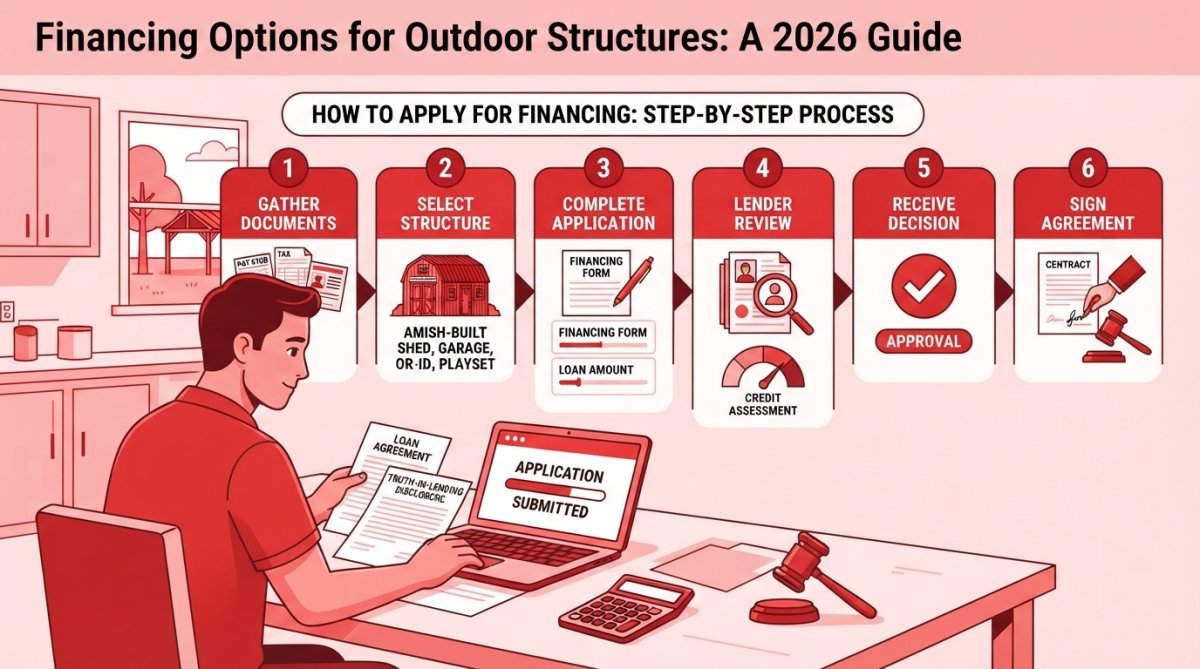
Gather Required Documentation
Before you apply, collect the documents lenders will ask for. You’ll need recent pay stubs (typically the last 2-3 months), tax returns (usually the last 2 years), and a government-issued ID. Have your Social Security number ready. If you’re self-employed, lenders may ask for additional documentation like profit-and-loss statements or business tax returns. Have information about your bank accounts, existing debts, and monthly obligations. If you’re applying for a HELOC, gather your mortgage statement and information about your home’s estimated value.
Complete Your Financing Application
Applications can be completed online, by phone, or in person. Online applications are typically the fastest, taking 10-15 minutes. Be honest and accurate on your application. Lenders verify information, and providing false information can result in application denial or loan cancellation. After you submit your application, respond promptly to any requests for additional information to keep the approval process moving.
Understand Your Loan Terms and Monthly Payments
Once approved, the lender provides a loan estimate that shows your interest rate, monthly payment, loan term, and total cost. Review this carefully before signing. If you’re financing $12,000 at 9% APR for 5 years, your monthly payment is approximately $248. Over 60 months, you’ll pay about $14,880 total, with $2,880 in interest. Pay attention to any fees. Some lenders charge origination fees (1-5% of the loan amount), prepayment penalties (if you pay off early), or late fees (if you miss a payment). At Riehl Structures, we work with financing partners who don’t charge prepayment penalties, so you can pay off your structure early without additional costs.
| Step | Duration | Key Actions |
|---|---|---|
| Gather documentation | 1-2 days | Collect pay stubs, tax returns, ID, account info |
| Complete application | 15-30 minutes | Fill out online, phone, or in-person application |
| Lender review | 1-3 business days | Lender verifies information and may request more docs |
| Approval decision | 1-5 business days | Receive approval, loan estimate, and terms |
| Sign documents | 1 day | Review and sign loan agreement |
| Receive funds | 1-5 business days | Funds transfer to your account or directly to dealer |
Evaluating Total Cost of Ownership Before You Commit
Before you sign financing paperwork, calculate what your outdoor structure will actually cost you over time.
Calculate Interest Costs and Hidden Fees
Start with the purchase price of your structure. Add all financing costs: interest, origination fees, appraisal fees (if applicable), and any other charges. For example: A $12,000 shed financed at 9% APR for 5 years costs $248 per month. Over 60 months, you pay $14,880 total. Your interest cost is $2,880. If there’s a $300 origination fee, your total cost is $15,180. Now compare this to the structure’s expected impact on your home value. If the shed increases your home’s value by $6,000, your net cost is $15,180 minus $6,000, or $9,180. Hidden fees sometimes appear in financing agreements. Late payment fees (typically $25-50) apply if you miss a payment. Ask your lender for a complete list of all possible fees before signing.
Early Payoff Options and Prepayment Penalties
Some lenders charge prepayment penalties if you pay off your loan early. Before accepting financing, ask specifically: "Are there prepayment penalties if I pay off this loan early?" If the answer is yes, ask how much they are and whether they apply for the entire loan term or just the first few years. Choosing a lender without prepayment penalties gives you flexibility. If your financial situation improves and you want to pay off your structure faster, you can do so without penalty. At 9% APR, paying off a $12,000 loan in 3 years instead of 5 years costs approximately $13,200 total versus $14,880 for 5 years, a savings of $1,680.
Financing an outdoor structure is a practical way to add value to your home and create a space where memories are made. The right financing option depends on your credit score, available down payment, home equity, and preference for payment predictability. Whether you choose rent-to-own, a fixed-rate loan, same-as-cash financing, or a HELOC, the key is understanding the total cost and ensuring the monthly payment fits your budget.
At Riehl Structures, we’ve helped hundreds of homeowners navigate financing options with flexible payment plans, no prepayment penalties, and no home equity required. Our Amish-built structures are designed to last decades, making them excellent long-term investments. When you’re ready to transform your backyard into an outdoor living space, get a quote from Riehl Structures and explore how our financing partners can make your project affordable today.
Frequently Asked Questions
What are the main financing options available for outdoor structures?
The primary financing options for outdoor structures include rent-to-own programs, fixed-rate home improvement loans, same-as-cash deferred interest plans, personal loans, and home equity lines of credit (HELOCs). Each has different approval timelines, interest rates, and credit requirements. Rent-to-own typically requires no credit check, while traditional loans depend on your credit score. Many financing partners offer flexible payment options ranging from 12 to 84 months, with APR ranges varying based on your creditworthiness and the loan structure.
How does rent-to-own financing for sheds work, and what's the total cost?
Rent-to-own programs allow you to make monthly payments toward ownership of your outdoor structure. Typically, a portion of each payment builds equity toward the purchase. The key advantage is flexible approval, many rent-to-own options don't require a credit check. However, the total cost of ownership can be significantly higher than a traditional loan because you're paying rent plus a purchase option. Always compare the full payoff amount to fixed-rate loan options before committing to ensure you understand the long-term financial commitment.
What credit score do I need to qualify for shed financing with no credit check?
Build-now-pay-later and no-credit-check financing options don't require a traditional credit check, making them accessible even if you have poor or no credit history. However, some programs may verify income or employment rather than pulling your credit report. If you're concerned about your credit score, ask your financing partner specifically about their approval criteria. These flexible options typically come with higher interest rates than traditional loans, so factor that into your total cost of ownership calculation.
How does a HELOC for outdoor renovations compare to a personal loan?
A HELOC uses your home equity as collateral, typically offering lower interest rates than personal loans but requiring you to have built equity in your home. Personal loans are unsecured, meaning no collateral is needed, but usually carry higher APR ranges. HELOCs impact your home equity and may affect your resale value if not managed carefully. Personal loans have fixed monthly payments and don't put your home at risk. For outdoor structures, a personal loan may be simpler if you have good credit; a HELOC works better for larger projects where the lower rate justifies the complexity.
This article was written using GrandRanker

Copy Link