Best Backyard Playset Accessories for Toddlers: 2026 Guide
Copy Link

Table of Contents
- Best Backyard Playset Accessories for Toddlers: Top Picks Compared
- Safe Playset Accessories for 2-Year-Olds
- Playset Safety Guidelines for Toddlers
- Motor Skill Development Through Active Play
- How to Install Playset Accessories Correctly
- Sensory Play and Imaginative Exploration
- Weather-Resistant Materials and Long-Term Durability
- Budget-Friendly Modular Upgrade Paths
Last Updated: July 14, 2026
Best Backyard Playset Accessories for Toddlers: Top Picks Compared
When parents invest in a backyard playset, they’re making a commitment to outdoor play and childhood development. The base structure is only the beginning, the right accessories transform a simple frame into an adventure zone. Finding the best backyard playset accessories for toddlers requires understanding what supports safe, engaging play at each developmental stage.
At Riehl Structures, we’ve helped families in the West Chester and King of Prussia areas customize their outdoor spaces for years. We know that toddlers need thoughtfully designed accessories that match their developmental stage, keep them secure, and hold up through Pennsylvania weather.
The best accessories aren’t always the most expensive ones. A high-back bucket swing for a 2-year-old delivers more developmental benefit than a steering wheel. Match accessories to your child’s current abilities, not their future ones.
Quick Comparison Table
| Accessory Type | Best For | Key Feature | Price Range |
|---|---|---|---|
| Bucket Swing | Ages 2-4 | High-back support, secure seating | $45-65 |
| Nest Swing | Ages 2-5 | Stable, shared play, lounging | $60-80 |
| Climbing Cargo Net | Ages 3-7 | Upper body strength, coordination | $85-110 |
| Steering Wheel | Ages 2-5 | Imaginative play, role-play | $15-25 |
| Toy Telescope | Ages 2-5 | Sensory exploration, pretend play | $15-25 |
| Music Kit | Ages 2-6 | Sensory development, creativity | $70-85 |
| Monkey Bar Rungs | Ages 3-6 | Arm strength, confidence building | $35-50 |
| Canopy Roof Tarp | All ages | Sun protection, weather resistance | $50-70 |
Safe Playset Accessories for 2-Year-Olds
Toddlers aged 2 to 3 need accessories designed for their size, strength, and developmental stage. Many parents buy accessories rated for "ages 2 and up" without checking weight limits or whether the piece fits their child’s physical capabilities. The safest accessories prioritize security over complexity.
Bucket Swings: Security and Comfort
A high-back bucket swing is the gold standard for toddler swinging. Unlike traditional belt swings that require a child to hold on and maintain balance, a bucket swing wraps around your child’s body, supporting their back, sides, and bottom. The Gorilla Playsets Full Bucket Toddler Swing includes a polymer molded seat with UV protection and galvanized hangers rated for outdoor durability.
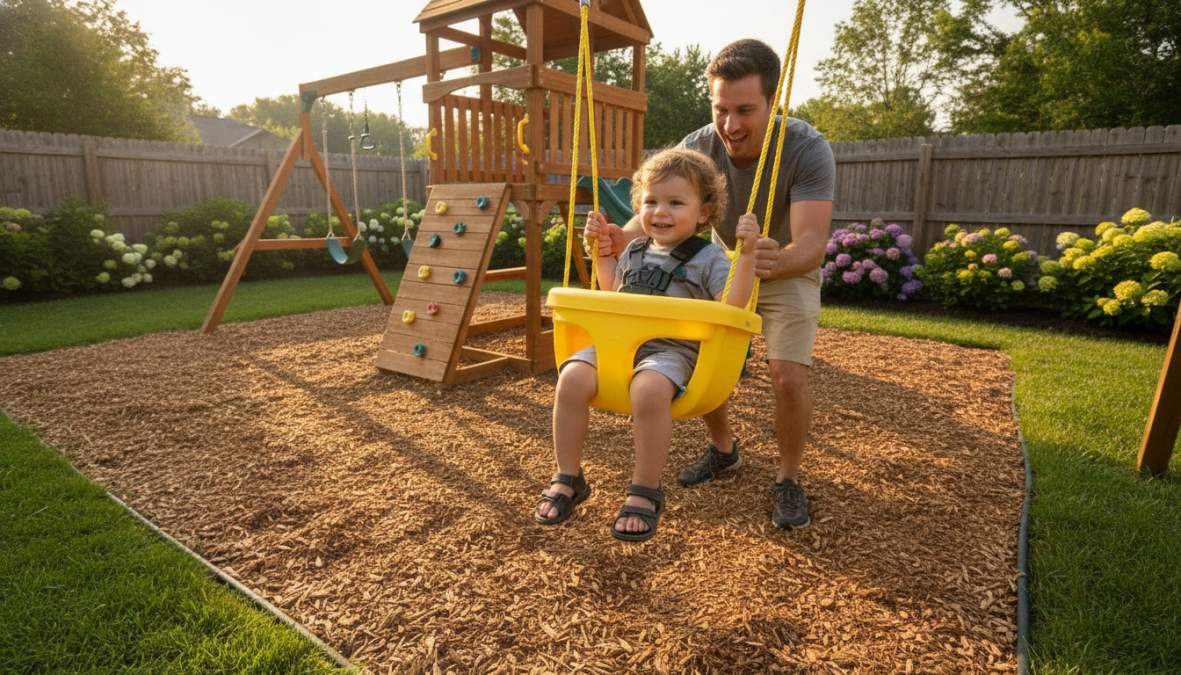
Your child can’t fall out sideways or backward. The high back prevents their head from tilting too far back. This security means they can relax into the swinging motion instead of tensing up from fear. Research from playground safety organizations shows that secure seating dramatically reduces anxiety in young swingers, allowing them to enjoy the experience.
Most bucket swings top out at 50 pounds, meaning your child will outgrow it around age 4 or 5. Plan on this accessory as a temporary investment in toddler-specific play. Installation is straightforward: you’re hanging a seat between two chains. The critical part is ensuring your chains attach to a beam that can handle the dynamic load, not just the child’s weight, but the force created by swinging.
Never leave a toddler unattended in a bucket swing. Even though bucket swings are secure, constant supervision is non-negotiable.
Nest Swings: Stable Alternatives
A nest swing (or saucer swing) offers a different experience than a bucket. Your child sits in a large fabric sling suspended by multiple attachment points. The Gorilla Playsets Nest Swing supports multiple children and allows for lounging, opening up different types of play.
Nest swings work well for toddlers who have some coordination but still need security. The large surface area means a child can shift positions without the seat tipping. Two toddlers can swing together, developing social skills. The fabric construction is gentler on the body than hard plastic seats. Weight capacity typically runs 150-200 pounds, making it a better long-term value than a bucket swing if your family plans to use the playset for several years.
Playset Safety Guidelines for Toddlers
Safety isn’t an accessory you add to a playset, it’s a foundation that determines whether every other accessory will be safe to use. Most parents know they need protective surfacing under swings, but they don’t know about the specific standards that actually matter.
Weight Capacity and Age-Appropriate Selection
Every playset accessory comes with a weight limit and age recommendation. These aren’t suggestions, they’re engineering specifications based on testing. Exceed the weight limit and hardware can fail. Use an accessory below the recommended age and the child might not have the coordination to use it safely.
A 50-pound limit on a bucket swing includes the dynamic forces created by swinging. When a child swings, they experience forces greater than their body weight at the arc’s highest point. Age recommendations come from developmental research about coordination, strength, and judgment.
Buy for your child’s current size and abilities, not for them to “grow into.” You can always add more challenging accessories as they develop.
Protective Surfacing and Installation Standards
The area under and around your playset needs protective surfacing: mulch, sand, rubber mats, or engineered wood fiber. This isn’t optional, it’s the difference between a fall being a scraped knee and a head injury.
The depth of protective surfacing depends on equipment height and fall surface type. A playset with a 4-foot deck height needs 9 inches of engineered wood fiber or mulch. A 6-foot height needs 12 inches. According to ASTM standards, surfacing needs to extend at least 6 feet in all directions from the equipment.
Installation hardware must be galvanized or stainless steel to resist rust and corrosion. Regular steel bolts will rust in a few years, weakening connections. Use the hardware specified by the manufacturer. Substituting a cheaper bolt or different size hanger compromises safety.
Motor Skill Development Through Active Play
The best backyard playset accessories develop specific motor skills your child needs at their current stage. At ages 2-3, toddlers are developing gross motor skills: running, climbing, jumping, and throwing.
Climbing Walls and Cargo Nets
A climbing cargo net transforms a playset into a place to explore vertical space. The Swing-N-Slide Climbing Cargo Net uses heavy-duty rope construction that allows children to pull themselves up using their arms and legs simultaneously. This develops upper body strength, core stability, and problem-solving as children figure out how to navigate the net’s irregular surface.
Cargo nets work differently than ladder-style climbing. A net has an irregular surface where each step requires slightly different positioning. This unpredictability strengthens neural pathways related to balance and spatial awareness. The net also teaches risk assessment in a controlled way, building confidence for later climbing challenges.
Installation requires careful attention to tension. A cargo net that’s too loose will sag and be harder to climb. One that’s too tight will stress attachment points.
Monkey Bars and Upper Body Strength
Monkey bars require grip strength, shoulder stability, and the coordination to time arm movements while your body is suspended. The Creative Cedar Designs Monkey Bar Rungs come as a set of 6 metal rungs rated for durability and rust resistance.
Most 2-year-olds won’t have the grip strength to hang independently. Most 3-year-olds can hang briefly but won’t swing across. By age 4-5, children start making real progress. The value of monkey bars for toddlers is often just hanging, learning that they can support their own weight briefly, and feeling their grip strengthen over weeks and months.
How to Install Playset Accessories Correctly
Installation mistakes are where most safety problems start. A perfectly safe accessory installed incorrectly becomes a liability. Most accessories follow similar installation principles.
Installation Hardware and Ground Anchors
Every playset accessory needs to be anchored securely to the frame using bolts, brackets, and hangers rated for outdoor use. Galvanized steel is the minimum standard. Stainless steel is better but more expensive.
Ground anchors matter for the playset frame itself. A playset bolted to the ground stays in place during wind and dynamic forces created by children jumping and swinging.
The installation process for most accessories follows this pattern:
- Locate the attachment points on your playset frame
- Drill pilot holes if needed (prevents splitting in wood)
- Install bolts or hangers using the specified hardware size
- Tighten to snug, not maximum force
- Check tension after one week of use and after seasonal weather changes
Never use roofing nails or wood screws to attach playset accessories. These fasteners aren’t designed for the dynamic loads created by swinging and climbing. Use bolts rated for outdoor play.
Common Installation Mistakes to Avoid
The most common mistake is underestimating the forces involved. A child swinging creates forces far greater than their body weight. Playset hardware is engineered for these forces, but only if installed correctly.
The second mistake is mixing hardware types. Using a stainless steel bolt with a galvanized washer creates a corrosion point where different metals meet. The third mistake is assuming installation is "good enough" after initial setup. Bolts loosen over time from vibration and use. Check all bolts after two weeks and again after a month. After that, a seasonal check (spring and fall) catches most problems before they become safety issues.
Sensory Play and Imaginative Exploration
The best backyard playset accessories develop sensory exploration and imaginative play alongside physical development. A toddler who can swing and climb is developing physically, but a toddler who can also pretend and explore is developing cognitively and emotionally.
Music Kits and Interactive Elements
The Swing-N-Slide Outdoor Rhythm Band Music Kit brings sound and rhythm to the playset. Children can create music, experiment with different tones, and develop rhythm and coordination. Music play develops different neural pathways than physical play, engaging auditory processing, timing, and pattern recognition.
Music kits typically bolt to the playset deck and last longer if positioned under a canopy.
Role-Play Accessories: Telescopes and Steering Wheels
The Gorilla Playsets Toy Telescope and Creative Cedar Designs Playset Steering Wheel transform the playset into a vehicle or exploration base. These accessories don’t have mechanical function, they’re purely imaginative. A simple steering wheel lets the child decide what story to tell.
Imaginative play develops executive function, problem-solving, and social skills. When two children play on a playset with a steering wheel, they’re negotiating who gets to steer and where they’re going. These role-play accessories are also the most affordable way to add play value to your playset, ranging from $15-25.
Weather-Resistant Materials and Long-Term Durability
A playset accessory that lasts one summer isn’t a good investment. The best accessories handle Pennsylvania’s weather: hot summers, cold winters, heavy spring rains, and seasonal temperature swings.
UV Protection and Cedar Wood Benefits
Most quality playset accessories use UV-protected plastic or treated wood. UV protection prevents fading and brittleness caused by sun exposure. A plastic seat without UV protection will become brittle and crack within a few years. One with UV protection stays flexible and functional for 10+ years.
Cedar wood naturally resists rot and insect damage because it contains natural oils that make it less appealing to fungi and pests. Cedar playsets require less chemical treatment than other woods. Cedar costs more than pressure-treated pine, but the investment pays off. A cedar playset lasts 15-20 years with basic maintenance.
For accessories, look for galvanized metal or stainless steel hardware. Galvanized steel is steel coated with zinc, which prevents rust. It’s the standard for outdoor playground equipment.
Climate-Specific Maintenance for Year-Round Play
Pennsylvania weather creates specific maintenance challenges. Winter freezing and thawing cycles loosen bolts. Spring rains create moisture that promotes mold growth on fabric accessories.
The Swing-N-Slide Extra Duty Canopy Roof Tarp protects the playset deck from direct sun and rain, extending the life of wood components and making the playset usable during light rain.
Seasonal maintenance checklist:
Spring: Check all bolts and tighten as needed. Inspect wood for splintering or rot. Remove leaves and debris from deck.
Summer: Monitor for mold or mildew on fabric accessories. Check that bolts haven’t loosened from vibration and heat.
Fall: Remove leaves regularly to prevent moisture accumulation.
Winter: Remove snow and ice from deck to prevent slipping. Check that bolts are still tight after temperature changes.
This maintenance takes 30 minutes per season.
Budget-Friendly Modular Upgrade Paths
You don’t need to buy every accessory at once. A smart approach starts with essentials (bucket swing, protective surfacing) and adds accessories as your child grows and your budget allows.
A modular upgrade path means each accessory builds on what you already have. Start with a basic playset frame and a bucket swing. In year two, add a cargo net as your child develops climbing skills. In year three, add role-play accessories as imaginative play develops. This approach spreads costs over time and ensures each new accessory matches your child’s current abilities.
The most important first addition is a bucket swing for younger toddlers or a nest swing for toddlers with more coordination. Add protective surfacing under and around the swing area, this is non-negotiable for safety.
The second addition is typically climbing elements (cargo net or monkey bars) as children approach age 3-4. The third addition is often role-play accessories (steering wheel, telescope) as imaginative play develops around age 3-4.
Creating a safe, engaging backyard playset for toddlers requires understanding what your child needs at their current developmental stage, installing everything correctly, and maintaining it through Pennsylvania’s challenging weather. Riehl Structures specializes in custom-designed outdoor structures built with Amish craftsmanship and engineered for durability. Our team can help you design a playset that grows with your child. With flexible financing options and free delivery within 30 miles of our West Chester and King of Prussia locations, we make it easy to create a backyard where memories are made.
Frequently Asked Questions
What are the safest playset accessories for toddlers under 3?
The safest options include bucket swings with high-back support and secure hangers, nest swings for stable seating, and low-height climbing elements. Always verify weight capacity matches your toddler's size, ensure proper installation with ground anchors, and check that accessories meet ASTM safety standards. Avoid accessories with small parts that pose choking hazards, and prioritize weather-resistant, non-toxic materials.
How do I choose the right playset accessories for my toddler's developmental stage?
Match accessories to motor skill milestones: younger toddlers (18-24 months) benefit from bucket swings and nest swings that develop balance; ages 2-3 can handle low climbing nets and monkey bars for upper body strength; ages 3+ are ready for more complex climbing structures. Select age-appropriate items with clear weight limits, and prioritize accessories that encourage active play and motor skill development while maintaining safety.
What should I know about installing playset accessories safely?
Proper installation requires correct hardware, ground anchors for stability, and following manufacturer guidelines precisely. Ensure the playset sits on protective surfacing like mulch or rubber mats to cushion falls. Check all bolts and connections regularly, especially before seasonal use. If retrofitting older sets, verify structural integrity first. Many installation mistakes involve inadequate anchoring or improper tension on rope elements, take time to review each step carefully.
Are there budget-friendly ways to expand a playset without buying a new one?
Yes. Look for modular add-ons like steering wheels, toy telescopes, and play phones that mount easily to existing structures at lower price points. Climbing cargo nets and monkey bar rungs offer great motor skill development without major investment. Consider seasonal upgrades, adding one accessory per year spreads costs. Ask manufacturers about refurbished or clearance items, and explore DIY safety retrofitting for older sets to extend their useful life before purchasing new equipment.
This article was written using GrandRanker

Copy Link

