Maintain Wooden Outdoor Furniture in Humid Climates
Copy Link

Table of Contents
- Why Humidity Damages Wooden Outdoor Furniture
- Best Wood Types for Humid Climates
- Best Wood Sealers for Humid Climates
- Step-by-Step Guide: How to Maintain Wooden Outdoor Furniture in Humid Climates
- How to Remove Mold from Outdoor Wood Furniture
- Preventing Wood Rot in Outdoor Furniture
- Hardware Maintenance for Humid Environments
- Common Mistakes to Avoid When Maintaining Wooden Outdoor Furniture
Last Updated: July 2026
Why Humidity Damages Wooden Outdoor Furniture
Humidity is the silent enemy of outdoor wood. When moisture penetrates the grain, it causes swelling, warping, and rot. Wood absorbs water like a sponge, expanding and contracting repeatedly as humidity fluctuates. This constant movement stresses wood fibers, causing cracks, splits, and surface checking. Trapped moisture creates the perfect environment for mold and mildew, accelerating decay and discoloring the finish.
The problem intensifies in genuinely humid climates, monsoon regions, coastal areas, or places with high annual rainfall. A protective sealant creates a barrier, but without proper maintenance, water finds its way in through microscopic cracks, gaps around hardware, and worn finish edges.
Ignoring humidity damage early means expensive repairs or replacement within 3-5 years. A $2,000 furniture set can become worthless if moisture reaches the structural wood grain.
Best Wood Types for Humid Climates
Not all wood species handle moisture equally. Choosing rot-resistant wood is the first line of defense when building or buying outdoor furniture for humid environments.
Teak stands as the gold standard. Its natural oils repel water and resist decay for decades with minimal maintenance. Ipe (Brazilian walnut) is nearly as durable and harder than teak, making it excellent for high-traffic pieces. Cumaru offers similar rot-resistance at a lower price point than teak.
For budget-conscious buyers, cedar and redwood are decent North American choices. Both contain natural tannins that provide some decay resistance, though neither matches teak’s longevity. Pressure-treated pine is affordable but requires resealing every 1-2 years as protective chemicals leach out.
Rot-Resistant Species Worth Considering
Cumaru offers excellent rot-resistance and hardness comparable to ipe, with a warm golden-brown color that darkens beautifully with age. Acacia is trending in modern outdoor furniture, moderately rot-resistant, harder than cedar, and more affordable than teak. For humid climates, acacia works well if sealed properly and given consistent maintenance.
| Wood Species | Rot Resistance | Hardness | Cost Level | Best For | Maintenance Frequency |
|---|---|---|---|---|---|
| Teak | Excellent | Moderate | High | High-end pieces, minimal maintenance | Every 2-3 years |
| Ipe | Excellent | Very High | High | Heavy-use furniture, decking | Every 2-3 years |
| Cumaru | Excellent | Very High | Moderate | Durable outdoor sets | Every 1-2 years |
| Cedar | Good | Soft | Low | Budget pieces, protected areas | Every 1-2 years |
| Acacia | Good | Moderate | Moderate | Modern designs, casual use | Every 1-2 years |
| Pressure-treated Pine | Fair | Soft | Low | Temporary pieces | Every 1-2 years |
Best Wood Sealers for Humid Climates
The right sealant is your furniture’s primary defense against moisture and mildew. In humid climates, you need a finish that adheres well, resists UV damage, and requires reapplication on a predictable schedule.
Polyurethane-based sealants offer excellent water repellency and durability, lasting 2-3 years in humid conditions. Spar urethane (marine-grade polyurethane) flexes slightly as wood expands and contracts, preventing cracking better than rigid finishes, ideal for humid climates. Teak oil penetrates the wood grain and enhances natural appearance but requires annual reapplication. Exterior wood wax creates a matte finish and is easier to reapply than varnish, though it needs reapplication every 6-12 months in humid regions.
Eco-Friendly & Non-Toxic Sealant Options
Water-based polyurethane eliminates most VOCs while maintaining good water resistance. It’s safer to apply indoors but slightly less durable than oil-based polyurethane, requiring reapplication every 18-24 months.
Natural plant-based oils (linseed, walnut, or coconut oil blends) offer minimal toxicity and enhance wood grain beautifully but provide less waterproofing than synthetic sealants. Beeswax and plant-oil blends create a semi-protective finish with virtually no toxins, ideal for furniture you’ll touch frequently, though they require resealing every 6-9 months.
Layer your sealants for maximum protection: apply a penetrating eco-friendly oil first, then top with water-based polyurethane. This hybrid approach balances durability with lower toxicity.
Step-by-Step Guide: How to Maintain Wooden Outdoor Furniture in Humid Climates
Maintaining wooden outdoor furniture in humid climates requires consistency. The steps below form a year-round routine that prevents moisture damage, mold growth, and premature wood decay.
What You’ll Need Before Starting
Gather these supplies: microfiber cloth or soft-bristled brush, mild cleaning solution (water + dish soap), bucket for rinsing, sandpaper (120-grit and 220-grit), wood sealant, paintbrush or applicator pad (2-3 inches wide), dehumidifier (optional but recommended for covered storage), breathable furniture covers, and stainless steel hardware replacement if upgrading from corroded fasteners.
Step 1: Clean and Dust Your Furniture Regularly
Dust and debris trap moisture against the wood surface. Wipe down all surfaces weekly during humid seasons with a microfiber cloth. For deeper cleaning, use mild dish soap and water with a soft-bristled brush, working in the direction of the wood grain. Rinse thoroughly and dry immediately with a microfiber cloth. Never leave water sitting on the surface.
Pay special attention to crevices, seat slats, and areas where water pools. Use an old toothbrush to clean tight corners where mildew breeds.
Time: 15-30 minutes per furniture piece
Step 2: Apply and Reapply Protective Sealants
Sealants are your furniture’s primary defense against moisture. In humid climates, reapplication is essential, not optional.
Start by assessing your current finish. If the sealant is peeling, chalky, or water no longer beads on the surface, it’s time to reseal.
Application steps:
- Sand the surface lightly with 120-grit sandpaper to remove loose finish and smooth the grain
- Wipe away all dust with a damp cloth and allow to dry completely (at least 2 hours in humid conditions)
- Apply sealant with a brush or pad, following the wood grain
- Allow the first coat to dry per manufacturer instructions (typically 4-8 hours)
- Sand lightly with 220-grit sandpaper between coats
- Apply a second coat for maximum protection
- Allow full curing before using the furniture (usually 24-48 hours)
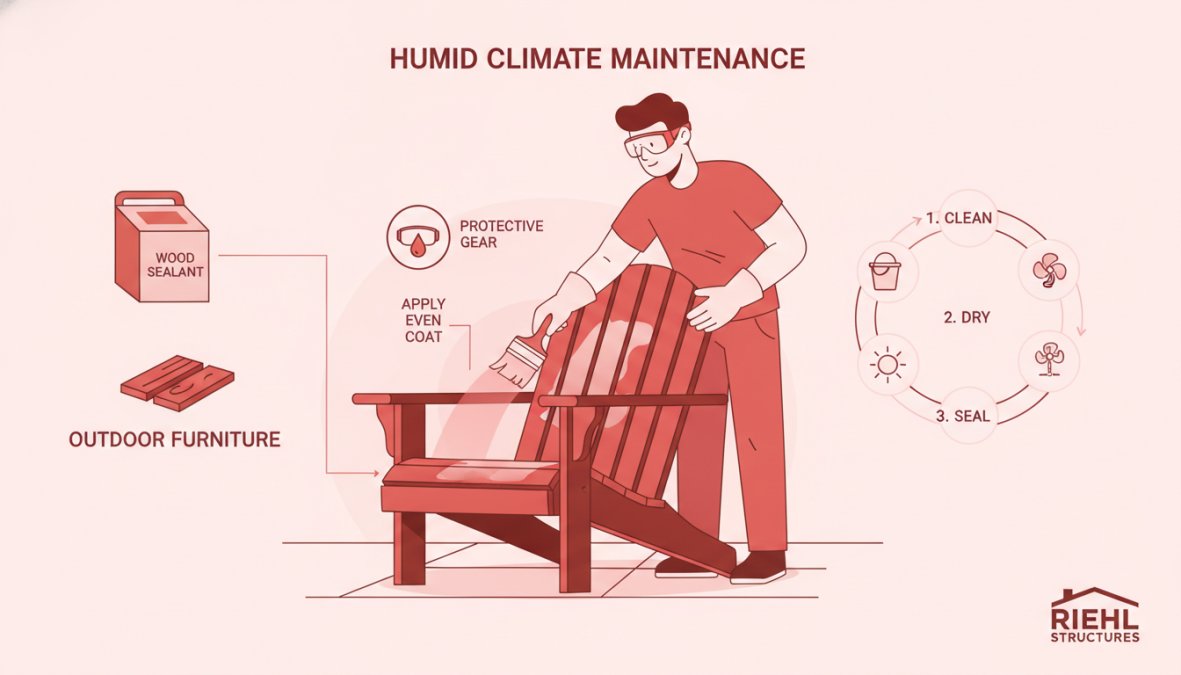
In humid climates, plan to reseal outdoor furniture every 12-24 months depending on your sealant type. Polyurethane lasts longer (24-36 months) than wax or oil finishes (12-18 months).
Time per application: 1-2 hours (plus drying time)
Step 3: Control Humidity Levels Around Your Furniture
Humidity levels above 60% accelerate wood decay and mold growth. If your furniture lives in a covered patio or storage area, humidity control becomes practical.
A dehumidifier removes moisture from the air. For a covered patio or screened room, a mid-sized dehumidifier (30-50 pint capacity) maintains humidity in the 40-50% range. For storage areas, run the dehumidifier for several hours before storing furniture for winter or extended periods.
Monitor humidity with an inexpensive hygrometer (digital humidity meter). Track readings weekly during humid seasons to understand your microclimate.
Step 4: Ensure Proper Airflow and Ventilation
Stagnant air traps moisture. Position furniture away from walls and corners where air circulation is poorest. Leave at least 6-12 inches of space around each piece.
A ceiling fan or portable fan in a covered patio dramatically improves air movement. Run it during humid periods, especially early morning and evening when dew forms. For screened patios, ensure screens are clean and unobstructed. Windows and doors should remain open when weather permits, allowing humid air to escape.
Step 5: Protect from Direct Sunlight and Weather
UV radiation degrades wood sealants and causes wood to gray and become brittle. Use breathable covers (canvas or specialized furniture covers) rather than plastic, which traps moisture underneath. Position covers so they don’t rest directly on the wood.
For permanent outdoor furniture, consider a pergola, shade sail, or tree canopy. Dappled shade reduces UV exposure while allowing air circulation. During monsoon season or extended rainy periods, move furniture under cover or use protective covers.
Time: 10-15 minutes to properly cover furniture
How to Remove Mold from Outdoor Wood Furniture
Mold and mildew appear as dark spots or fuzzy coating on the wood surface. For surface mold, mix equal parts white vinegar and water in a spray bottle. Spray the affected area and let it sit for 10-15 minutes. Scrub gently with a soft-bristled brush, working in the direction of the grain. Rinse thoroughly and dry completely.
For stubborn mold, use a solution of one part bleach to three parts water. Apply the same way: spray, wait 10-15 minutes, scrub gently, rinse, and dry. Never pressure wash moldy wood, the high-pressure water forces moisture deeper into the grain.
After removing mold, identify why it developed. Poor ventilation? Moisture pooling? Sealant failure? Address the root cause or mold returns within weeks.
If mold penetrates deep into the wood (dark staining that doesn’t wash away), the wood is beginning to decay. Sand away the affected area and reseal immediately, or replace the furniture piece if damage is extensive.
Preventing Wood Rot in Outdoor Furniture
Rot occurs when moisture reaches the wood grain and fungal decay begins. Once rot starts, it spreads quickly. Prevention is vastly easier than repair.
The three conditions that enable rot are moisture, oxygen, and temperature above 40°F. You can’t eliminate temperature or oxygen in outdoor settings, so moisture control is your only lever.
Apply sealant before rot starts. A intact finish prevents water from entering the wood. Ensure proper drainage, water shouldn’t pool on furniture surfaces. Sloped seats, drainage holes in storage boxes, and tilted table tops all direct water away.
Keep hardware dry. Bolts, screws, and metal brackets corrode in humid conditions, creating gaps where water enters the wood. Stainless steel hardware resists corrosion far better than galvanized or painted alternatives.
Repairing Moisture-Damaged Wood
Early-stage moisture damage is repairable. If the wood is soft or spongy but not yet rotted, you can restore it.
Press a screwdriver or awl into the suspected area. If it sinks easily, the wood is compromised. Allow the wood to dry completely in a warm, dry location with good air circulation. Use a dehumidifier if available. Drying may take 1-2 weeks.
Once dry, sand away any discolored or soft wood with 120-grit sandpaper until you reach solid wood. Apply a wood hardener (available at hardware stores) to the sanded area. Once hardened, apply wood filler to any voids or gouges, sand smooth, and reseal the entire piece.
Time: 2-3 weeks (mostly drying time)
If the wood is rotted, crumbly, dark, and structurally weak, replacement is safer than repair.
Hardware Maintenance for Humid Environments
Metal hardware corrodes in humid climates, creating rust stains and gaps where water enters the wood. Inspect bolts, screws, brackets, and hinges monthly. Look for rust, corrosion, or looseness. Tighten any loose fasteners with the appropriate wrench or screwdriver.
If hardware shows rust, remove it and clean with a wire brush or steel wool. Dry completely and apply a thin coat of light machine oil or silicone spray to prevent future corrosion.
For furniture you plan to keep long-term, replace steel hardware with stainless steel equivalents. Stainless steel costs slightly more but resists corrosion indefinitely in humid climates.
Check wooden dowels or wooden pegs that hold joints together. In humid climates, these swell and can crack the surrounding wood. If a wooden dowel is loose, the joint may need re-gluing or replacement.
Common Mistakes to Avoid When Maintaining Wooden Outdoor Furniture
Using plastic covers. Plastic traps moisture underneath and accelerates decay. Always use breathable covers.
Neglecting resealing. Many owners seal furniture once and assume they’re done. In humid climates, annual or biennial resealing is necessary.
Pressure washing. High-pressure water forces moisture deep into the wood and damages the surface. Hand scrubbing is safer.
Ignoring early mold. A small mold spot today becomes a large problem in weeks. Address mold immediately with vinegar or dilute bleach.
Storing furniture in damp areas. A basement, garage, or shed with poor ventilation is worse than leaving furniture outside. Run a dehumidifier if you must store indoors.
Mixing wood types. If replacing a damaged component, match the original wood species. Different woods expand and contract at different rates.
Using the wrong sealant. Interior wood stains fail quickly outdoors. Always use exterior-grade sealants rated for outdoor use.
Skipping ventilation. Covered patios and storage areas with stagnant air develop mold faster than open-air furniture. Prioritize air circulation.
Maintaining wooden outdoor furniture in humid climates requires consistency, but the effort pays dividends in longevity and appearance. The key is understanding that humidity is your furniture’s primary enemy, control moisture and you control the furniture’s lifespan. For those seeking premium outdoor furniture built to withstand challenging climates, Riehl Structures crafts Amish-built pieces designed for durability and custom-tailored to your specific environment. Their attention to wood selection, joinery, and finishing ensures your investment lasts decades, not years.
Frequently Asked Questions
How often should you seal outdoor wood furniture in a humid climate?
In humid climates, reseal wooden outdoor furniture every 12-18 months, or sooner if you notice the protective sealant wearing away. High-moisture environments accelerate wood swelling and degradation, making frequent reapplication of polyurethane or teak oil essential. Check your furniture seasonally, if water beads no longer form on the surface, it's time to reapply the wood finish.
What is the best wood finish for humid climates?
Polyurethane and marine-grade wood wax offer excellent waterproofing for humid environments. Teak oil is also popular for rot-resistant woods. Choose finishes labeled weather-resistant and UV protection. For eco-conscious homeowners, plant-based waxes and non-toxic sealants provide comparable protection without harsh chemicals. Always apply finishes in dry conditions for best adhesion to the wood grain.
How do you prevent mold and mildew growth on wooden outdoor furniture?
Prevent mildew growth by ensuring proper air circulation, controlling humidity levels with dehumidifiers, and keeping furniture dry. Use outdoor furniture covers during monsoon seasons or heavy rain. Clean regularly with a microfiber cloth and mild cleaning solution. Avoid placing furniture directly against walls or in shaded, damp areas where moisture buildup occurs. Proper ventilation around your outdoor living space is critical.
Can you leave wooden furniture outside in high humidity?
You can leave solid wood furniture outside in humid climates if it's properly sealed and maintained. Choose rot-resistant wood species like teak or cedar. Apply protective sealants regularly, use outdoor covers during extreme weather, and ensure good ventilation. Monitor for wood decay and mildew growth. Without preventative care, wood expansion and moisture damage will accelerate, so maintenance is non-negotiable in high-humidity areas.
This article was written using GrandRanker

Copy Link