How to Choose a Backyard Playset: A 2026 Buyer’s Guide
Copy Link

Table of Contents
- How to Choose a Backyard Playset: Key Factors to Evaluate
- Wooden vs. Metal vs. Plastic Playsets: Material Comparison
- Backyard Playset Safety Standards Every Parent Should Know
- Measuring Your Space: Footprint and Clearance Zone Requirements
- How to Prepare Ground for Playset Installation
- Age-Appropriate Features and Play Capacity
- Installation and Assembly: DIY vs. Professional Installation ROI
- Maintenance, HOA Compliance, and Long-Term Value
Last Updated: July 4, 2026
How to Choose a Backyard Playset: Key Factors to Evaluate
Choosing a backyard playset requires evaluating safety standards, material durability, available space, age-appropriateness, installation logistics, and maintenance. A poorly chosen playset becomes an eyesore, safety liability, or expensive mistake. This guide walks you through the framework for assessing your family’s needs, measuring your space correctly, understanding material trade-offs, and avoiding common selection errors.
Before shopping, take photos of your backyard from multiple angles and measure the space with a tape measure. Most families underestimate how much room a playset actually needs, including required safety zones around it.
Defining Your Family’s Needs
Start by listing every child who will use the playset and their current age plus age in five years. A structure perfect for a four-year-old becomes boring by age eight. The best playsets accommodate a wide age range through adjustable swings, climbing walls, and monkey bars that challenge different skill levels.
Consider your children’s play styles. Some crave physical challenge and want to climb and test limits. Others prefer imaginative play and need a deck, roof, or enclosed spaces. Mismatching the playset to your child’s temperament guarantees underuse.
Setting a Realistic Budget
Backyard playsets range from under $500 for basic metal swing sets to $15,000+ for elaborate wooden structures. The cheapest options rarely last more than three seasons before rust or rot forces replacement. Mid-range playsets ($1,500-$4,000) typically deliver the best value for families planning to keep the structure 5-10 years.
Factor in hidden costs: delivery and installation ($300-$1,500), safety surfacing like mulch or rubber tiles ($200-$800), and ongoing maintenance ($100-$300 annually for wooden structures). Professional installation adds another $500-$2,000.
Wooden vs. Metal vs. Plastic Playsets: Material Comparison
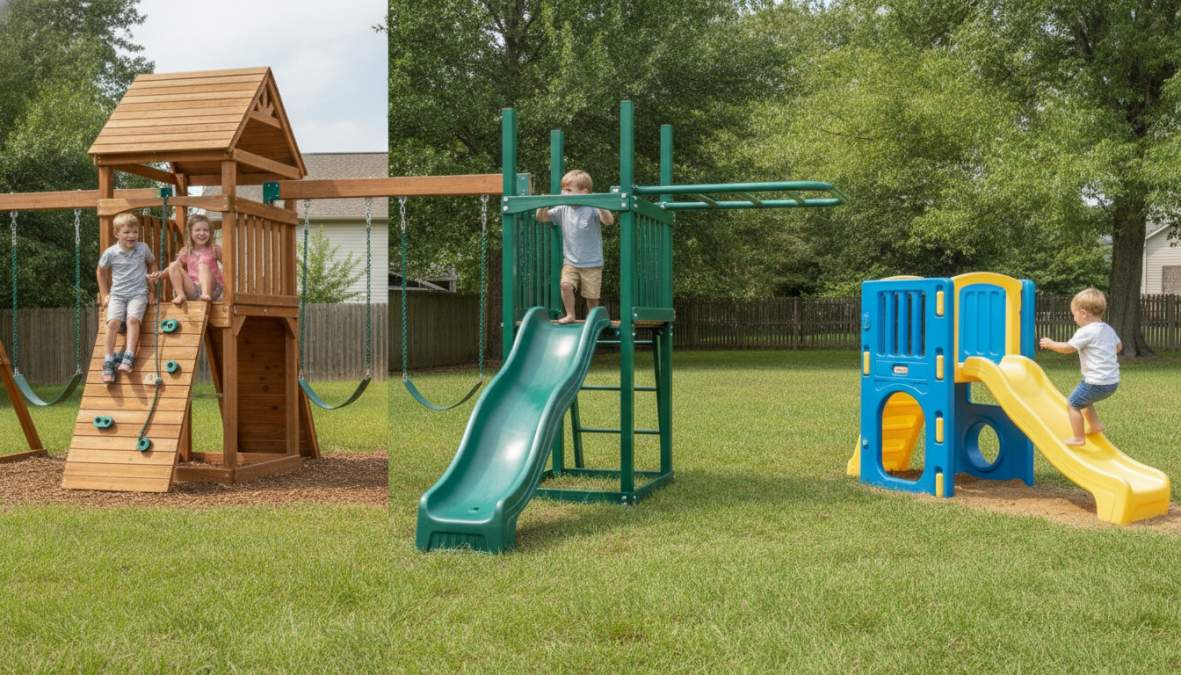
Each material has genuine trade-offs. There’s no universally "best" choice, only the best for your specific situation.
Wooden Playsets (Cedar & Redwood)
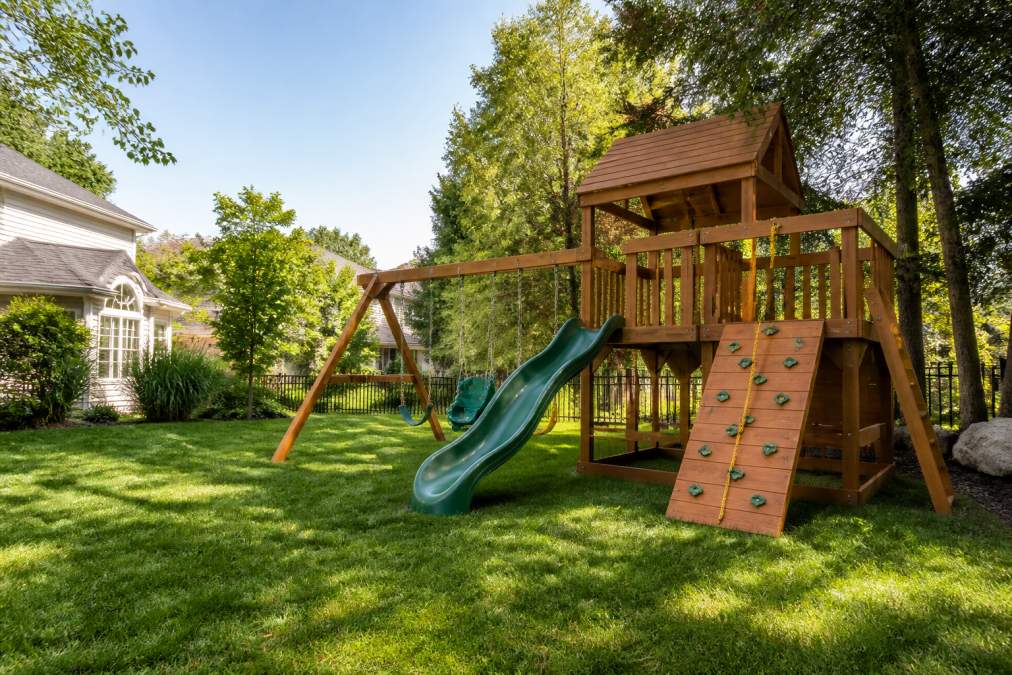
Wooden playsets offer aesthetic appeal and excellent weight capacity for climbing structures. Cedar and redwood are naturally rot-resistant. Wooden structures feel warm, look beautiful, and integrate seamlessly with landscaping.
The catch: wooden playsets demand consistent maintenance. Every 12-18 months, inspect for rot, replace corroded hardware, and reapply stain or sealant. In humid climates, this maintenance is non-negotiable. A well-built wooden structure lasts 10-15 years with proper care. Wood handles temperature extremes better than metal or plastic, staying comfortable year-round.
Metal Playsets
Metal swing sets are affordable, require minimal maintenance, and take up less space. They’re lighter and easier to relocate. Metal structures have the longest warranties.
The downsides are significant. Metal gets extremely hot in direct sunlight and uncomfortably cold in winter. Metal playsets feel flimsy compared to wooden structures and offer limited climbing and play features. Most max out at supporting heavier children or multiple simultaneous users without wobbling. Rust is the other enemy, even powder-coated metal eventually shows rust at connection points. Metal playsets typically last 5-8 years before rust makes them unsafe.
Plastic Playsets
Plastic structures are lightweight, colorful, and require virtually no maintenance. They won’t rot, rust, or splinter. Plastic is ideal for small yards and younger toddlers (ages 2-5) because they’re lower to the ground.
The limitation: plastic doesn’t scale well. Most plastic playsets max out at age 6 or 7 before becoming too small for older kids. They offer fewer play features and less physical challenge. Plastic can become brittle in extreme cold and may crack or fade in intense sun. Plastic structures are best viewed as temporary solutions for young toddlers rather than long-term investments.
| Material | Durability | Maintenance | Cost | Best For | Key Drawback |
|---|---|---|---|---|---|
| Cedar/Redwood | 10-15 years | High (staining, sealing) | $2,500-$8,000+ | Families committed to upkeep; premium aesthetics | Ongoing maintenance required |
| Metal | 5-8 years | Low (occasional cleaning) | $400-$2,000 | Budget-conscious; small yards | Gets hot/cold; rust over time |
| Plastic | 5-7 years | Minimal | $300-$1,500 | Young toddlers (2-5); temporary use | Limited features; poor for older kids |
Backyard Playset Safety Standards Every Parent Should Know
Safety is the foundation of every responsible playset purchase. Understanding standards protects your children and shields you from liability.
ASTM and CPSC Guidelines
The American Society for Testing and Materials (ASTM) publishes ASTM F1148, the standard for home playground equipment. The Consumer Product Safety Commission (CPSC) issues aligned guidelines. These aren’t suggestions, they’re baseline safety expectations for any playset sold in the United States.
Standards cover fall height limits, spacing between components (to prevent head entrapment), weight capacity, hardware corrosion resistance, and structural integrity. Reputable manufacturers design playsets to meet or exceed these standards. Ask manufacturers for ASTM compliance documentation.
Key safety metrics include maximum fall height (typically 6 feet for residential playsets), minimum clearance zones (usually 6 feet on all sides), and proper spacing between climbing bars (no more than 3.5 inches to prevent head entrapment, no less than 1.5 inches to prevent finger pinching).
Never buy a playset from an unknown manufacturer without ASTM documentation. Cheap imports and homemade designs often ignore safety standards. A child’s head can become trapped in improperly spaced bars, or a fall from inadequate surfacing can cause serious injury.
Fall Zones and Safety Surfacing
The ground underneath a playset matters as much as the structure itself. Hard ground, concrete, or compacted soil provides almost no impact absorption. A child falling from 6 feet onto hard ground can suffer serious injury.
ASTM standards require engineered safety surfacing under and around elevated play structures. The two most common options are playground mulch and rubber tiles. Playground mulch (engineered wood fiber) is affordable and provides 6-8 inches of fall protection depending on depth. Rubber tiles offer better impact absorption and last longer but cost 2-3 times more.
Calculate required surfacing depth based on fall height. A playset with a 6-foot deck height requires 9-10 inches of mulch or equivalent rubber thickness. Surfacing must extend at least 6 feet in all directions from the structure’s perimeter, more if there are swings.
Measuring Your Space: Footprint and Clearance Zone Requirements
Backyard space often determines which playsets are feasible. Many families discover too late that their chosen playset doesn’t fit when accounting for required safety zones.
Measure your available yard space in feet, noting obstacles like trees, fences, patios, or utility lines. Call before you dig or install anything near utility lines.
Understand the footprint requirement, the actual physical space the playset occupies. A simple swing set might be 8 feet wide and 10 feet deep. A larger wooden structure could be 20 feet wide and 25 feet deep. Get exact dimensions from manufacturer specifications.
Then add the clearance zone, the safety buffer required around the entire structure. ASTM standards typically require 6 feet of clearance on all sides, though swings need additional clearance in their path (typically 2 feet in front and 6 feet behind). A playset with a 20×25-foot footprint actually needs a 32×37-foot space to meet safety requirements.
Measure twice and be honest about available space before committing to a purchase.
How to Prepare Ground for Playset Installation
Proper site preparation determines whether your playset remains level and stable for years or develops structural problems within months.
Site Assessment and Leveling
Assess your ground before installation. Is it relatively level, or does it slope significantly? Does water collect after rain? Are there rocks, roots, or compacted soil preventing proper leveling?
For wooden playsets, ground must be level to within 1 inch across the entire footprint. Uneven ground causes structural stress and accelerated wear. If your yard slopes, level the ground using topsoil and compaction, or choose a different location.
Clear the installation area of grass, weeds, and debris. Remove rocks or roots that would prevent full ground contact. If your ground is very soft or has poor drainage, add a gravel base layer to improve stability.
Safety Surfacing Installation
Install safety surfacing before the playset itself. Spread engineered wood fiber to the required depth (typically 9-10 inches for 6-foot fall heights). Rake it level and compact it slightly. Mulch settles over time, so plan to top it up annually. For rubber tiles, lay them according to manufacturer specifications, ensuring no gaps between tiles.
Install edging around the surfacing perimeter to contain mulch and prevent it from spreading into your lawn.
Age-Appropriate Features and Play Capacity
Features should match your children’s developmental stages. A structure that’s too advanced frustrates kids and creates safety risks. One that’s too simple gets abandoned quickly.
For toddlers (ages 2-4), focus on low-height structures with gentle slopes, short slides, and simple swings. Deck height should be no more than 3-4 feet. For early elementary (ages 5-7), moderate-height structures with swings, slides, climbing bars, and monkey bars work well. Deck height can reach 6 feet. For older children (ages 8-12), taller structures with challenging features appeal. Deck heights of 8 feet or higher are appropriate.
If your children span a wide age range, choose a playset with features at multiple difficulty levels. Verify weight capacity before purchasing, especially if you have older or larger children.
Installation and Assembly: DIY vs. Professional Installation ROI
Assembly complexity varies dramatically. A simple metal swing set might take 2-3 hours. A large wooden structure could require 20-40 hours of skilled assembly.
DIY Assembly Considerations
DIY assembly saves money but demands time, tools, and mechanical aptitude. For simpler metal or plastic playsets, DIY is often reasonable. For complex wooden structures, DIY becomes much riskier. Wooden playsets have dozens of bolts and joints that must be properly torqued and aligned. Loose hardware or misaligned joints create wobbling and accelerated wear.
Consider your actual availability. Tired assembly is unsafe assembly.
Professional Installation Benefits
Professional installers bring expertise, proper tools, and accountability. They know common assembly mistakes and how to avoid them. They’ll level the ground properly, assemble the structure with correct torque specifications, and verify stability before leaving.
The cost ($500-$2,000 depending on complexity) feels expensive until you consider the alternative: a wobbly playset requiring disassembly and reassembly, plus liability risk if improper assembly contributes to an accident. For wooden playsets, professional installation is strongly recommended.
Maintenance, HOA Compliance, and Long-Term Value
Playset ownership doesn’t end at installation. Long-term satisfaction depends on realistic maintenance expectations and understanding regulatory landscape around your property.
Ongoing Maintenance Schedules
Wooden playsets require the most maintenance. Every spring, inspect for soft wood (sign of rot), corroded bolts, and winter damage. Every 12-18 months, apply stain or sealant to exposed wood. Check all bolts and hardware, tightening or replacing any that are loose or corroded.
Metal playsets need less attention but still require annual inspection for rust. Tighten any loose bolts. Repaint or touch up powder coat if rust appears. Plastic playsets require minimal maintenance beyond occasional cleaning and inspection for cracks.
All playset types need regular safety surfacing maintenance. Mulch settles over time, reducing impact absorption. Plan to add fresh mulch annually.
Budget 2-3 hours annually for wooden playset maintenance. Skip this, and your investment deteriorates. Metal playsets need 1-2 hours annually. Plastic playsets need minimal upkeep but have shorter lifespans.
HOA and Zoning Compliance
Before purchasing, check local HOA rules and zoning regulations. Some HOAs restrict size, height, or color of outdoor structures. Some prohibit playsets entirely or require approval before installation. Zoning codes may limit structure height or setback distances from property lines.
Contact your HOA and local building department. Ask specifically about playsets. Most jurisdictions don’t require permits for residential playsets, but some do.
Resale Value and Lifecycle Management
A well-maintained wooden playset adds modest curb appeal and can appeal to families with young children when you sell. However, don’t expect significant resale value. Most buyers view it as a feature to remove.
Plan your purchase with an exit strategy. How long do you intend to keep it? When it’s time to remove the playset, you can donate it to a school or community organization, sell it, or disassemble and recycle the materials.
Choosing a backyard playset is a significant decision affecting your family’s outdoor life for years. The process requires balancing safety, durability, maintenance reality, budget constraints, and your children’s actual play needs. Riehl Structures specializes in custom-designed wooden playsets built with Amish craftsmanship, flexible financing options including Rent to Own with no prepayment penalties, and free delivery within 30 miles of our West Chester and King of Prussia locations. Whether you’re building your first playset or upgrading from an older structure, we help families create backyards where memories are made. Get a quote now and discover how a well-chosen playset transforms your outdoor space for the next decade.
Frequently Asked Questions
What age is appropriate for a backyard playset, and how do I choose features for different ages?
Age-appropriate playsets vary by developmental stage. Toddlers (2-4) need lower play deck heights and gentler features, while children 5-12 can handle climbing walls, monkey bars, and taller slides. When choosing a backyard playset, check manufacturer weight limits and age recommendations. Many families opt for modular designs that grow with their children, allowing you to add features as kids develop new skills and confidence.
How much space do I need for a backyard playset, and how do I measure clearance zones?
Most residential playsets require a footprint of 15×20 feet, but clearance zones extend beyond the structure itself. ASTM F1148 standards require fall zones (typically 6-9 feet) on all sides depending on play deck height. Before choosing a playset, measure your available space and ensure you have adequate clearance for swings, slides, and climbing features. Account for future landscaping and ensure the location receives appropriate sunlight without creating heat hazards on metal surfaces.
Is wood or plastic better for a backyard playset, and what maintenance should I expect?
Wooden playsets (cedar or redwood) offer natural aesthetics and durability but require regular staining and sealing every 1-2 years to prevent rot and weather damage. Plastic playsets need less maintenance but may fade and become brittle in extreme climates. Metal playsets are durable but can corrode and become too hot in sun. When choosing between materials, consider your climate, maintenance commitment, and budget. Pressure-treated lumber is more affordable but less rot-resistant than cedar or redwood.
What safety standards should I check before buying a backyard playset?
Verify that your chosen playset meets ASTM F1148 standards and CPSC guidelines for playground equipment. Check for proper anchoring systems, secure hardware, and certified safety surfacing like playground mulch or rubber tiles under fall zones. Inspect warranty coverage and structural integrity specifications. Ensure the manufacturer provides documentation of safety compliance and that weight limits match your children's needs. Professional installation often includes safety certification verification.
This article was written using GrandRanker

Copy Link