Backyard Playsets for Sale: 2026 Buying Guide
Copy Link
Table of Contents
- Top Backyard Playsets for Sale: Comparison & Pricing
- Best Material for Outdoor Playsets: Wood vs. Steel vs. Plastic
- Playset Safety Guidelines & ASTM Compliance
- Small Backyard Playset Ideas: Maximizing Limited Space
- Backyard Playset Installation Cost & Assembly Services
- Essential Playset Accessories & Customization Options
- Long-Term Maintenance: Keeping Your Playset Safe & Durable
- Why Choose Riehl Structures for Your Next Playset
Last Updated: July 2, 2026
When shopping for backyard playsets for sale, families face a bewildering array of choices. Wooden swing sets, steel structures, plastic playhouses, each comes with different price points, durability profiles, and safety considerations. This guide cuts through the noise and shows you exactly what to look for, how much you should expect to spend, and which solutions work best for different yard sizes and age groups.
Top Backyard Playsets for Sale: Comparison & Pricing
The market for backyard playsets has expanded dramatically, with quality options at nearly every price point, from budget-friendly entry-level sets to premium customizable systems. Understanding what you’re paying for at each tier is essential.
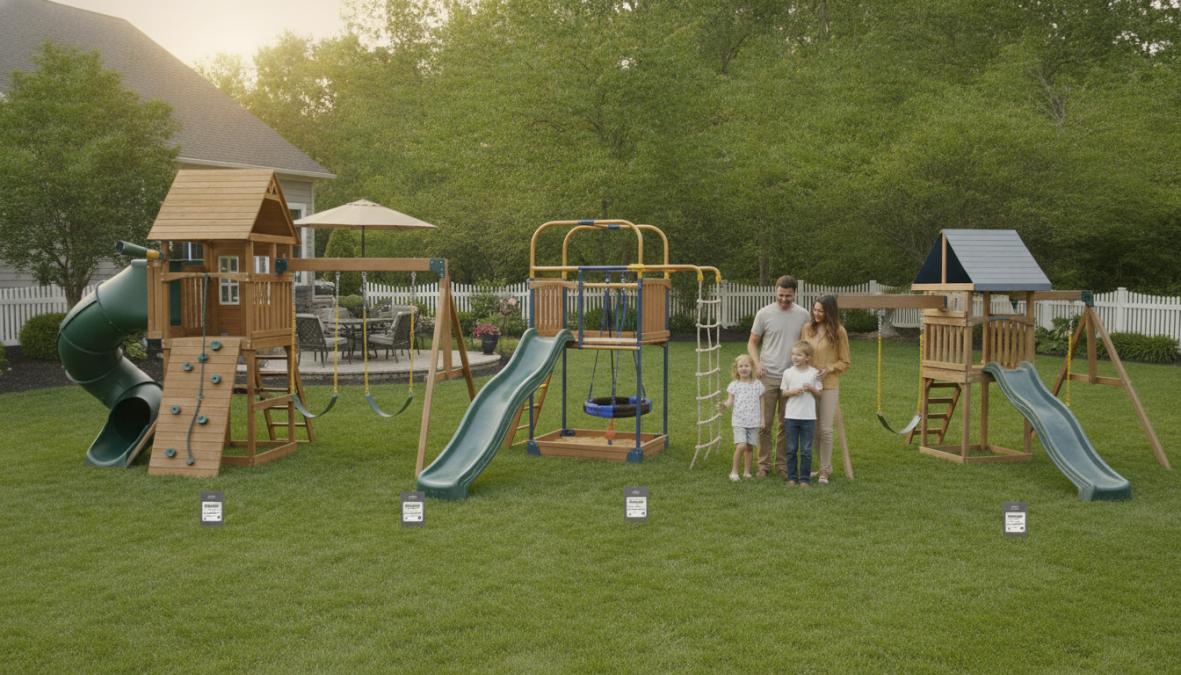
(/our-playsets/): Comparison & Pricing]
| Playset Option | Price Range | Best For | Key Features |
|---|---|---|---|
| KidKraft Ainsley Fort | $400-$700 | Budget-conscious families, small yards | Wave slide, 2 swings, rock wall, cedar wood |
| Backyard Discovery Cedar Cove | $2,199-$2,500 | Families wanting variety | Dual slides, canopy, sandbox, picnic table |
| Lifetime Adventure Castle | $2,299-$2,600 | Low-maintenance preference | Steel construction, climbing wall, weather-resistant |
| Rainbow Play Systems Castle Range | $5,000+ | Long-term investment seekers | Modular design, 100+ accessories, lifetime warranty |
| Riehl Structures Custom Playsets | Custom pricing | Families wanting personalized design | Amish-built quality, flexible financing, free local delivery |
Budget-Friendly Options ($400-$1,000)
The most affordable playsets typically feature cedar wood construction, which naturally resists rot without expensive treatment. KidKraft’s Ainsley Fort delivers surprising functionality, wave slide, belt swings, and rock wall, in a compact footprint.
Budget playsets sacrifice longevity. A set in this range may serve a single child through early years, then require replacement. Assembly typically takes 6-10 hours of DIY work. However, if you’re testing whether your family will actually use outdoor equipment before investing heavily, this is the right starting point.
Search YouTube for assembly videos of your specific model before purchasing. User-uploaded videos often reveal complications that manuals gloss over.
Mid-Range Playsets ($2,000-$3,000)
This tier represents the sweet spot for most suburban families. Backyard Discovery’s Cedar Cove and Lifetime’s Adventure Castle deliver multiple play activities with significantly better construction than budget options.
Cedar Cove uses all-cedar construction, requiring minimal maintenance for 3-5 years. Lifetime’s steel alternative eliminates wood maintenance entirely but runs hotter in direct sun. Both require professional installation or substantial DIY commitment (12-20 hours). Many families opt for professional installation, adding $500-$1,200 but ensuring structural integrity.
Premium & Customizable Systems ($5,000+)
Premium manufacturers build playsets lasting 15-20 years with proper maintenance. The difference is engineering: heavy-duty bolts, reinforced connection points, and modular design allow you to add features as children grow.
Riehl Structures offers custom-designed playsets built with Amish craftsmanship, tailored to your specific yard layout and budget. With flexible financing options including Rent to Own and free delivery within 30 miles of our West Chester and King of Prussia locations, premium quality becomes accessible without upfront payment.
Best Material for Outdoor Playsets: Wood vs. Steel vs. Plastic
The material choice determines maintenance burden, longevity, aesthetic appeal, and climate performance. There’s no universally "best" material, only the best fit for your priorities.
Cedar & Redwood Construction
Cedar and redwood naturally contain oils that resist rot and insect damage. They’re also beautiful, making them aesthetically appealing in yards.
The tradeoff is maintenance. Every 2-3 years, cedar playsets benefit from resealing or staining. Without maintenance, cedar degrades faster than untreated pressure-treated lumber. Wood construction works best in moderate climates; in the Pacific Northwest or Southeast, where moisture is constant, wood demands more vigilance.
Never paint wooden playsets with standard house paint. It traps moisture against the wood and accelerates rot. Use only exterior wood stain or sealant rated for playground equipment.
Weather-Resistant Steel & Metal Playsets
Steel playsets eliminate wood maintenance entirely. They won’t rot, splinter, or need resealing and can look nearly identical after 10 years.
The practical downside is heat absorption. On a 90-degree day, steel slides and handholds become uncomfortably hot for young children. Steel also rusts if the powder coating gets scratched. Steel playsets work well in high-moisture environments and are ideal for families who view maintenance as a dealbreaker.
Plastic Playsets for Low Maintenance
Plastic playsets require virtually no maintenance and won’t rot or rust. However, they’re best suited for toddlers and young children. As kids grow, plastic playsets show limitations: cracks develop, they become brittle in cold climates, and they offer less challenge than wood or steel. Most have a realistic lifespan of 5-8 years.
Playset Safety Guidelines & ASTM Compliance
Every playset should meet ASTM F1487, the standard for residential playground equipment. This standard addresses fall height, impact surface requirements, entrapment hazards, and structural integrity. Reputable manufacturers include ASTM compliance documentation with their products.
Safety Surface Requirements & Fall Protection
The ground surface matters more than most families realize. A child falling from a 6-foot-high playset onto bare ground faces serious injury risk. ASTM standards require engineered impact-absorbing surfaces, mulch, rubber tiles, or sand, with specific depth requirements based on fall height.
A structure with a maximum fall height of 6 feet requires at least 9 inches of engineered wood fiber mulch. This isn’t optional. Mulch needs refreshing every 2-3 years as it decomposes and compacts.
The most common safety failure isn’t defective equipment, it’s inadequate or poorly maintained ground protection. Budget as much for impact surface as you do for the playset itself.
Age-Appropriate Play Features & Weight Limits
Playsets are engineered for specific age ranges and weight limits. A structure designed for ages 3-8 has different clearances and fall heights than one for ages 5-12. Weight limits exist for structural reasons and shouldn’t be exceeded.
Age appropriateness also affects engagement. A 10-year-old will quickly outgrow a playset designed for preschoolers. Mid-range and premium systems often include modular add-ons, allowing you to adapt the structure as children age.
Small Backyard Playset Ideas: Maximizing Limited Space
Small-space optimization requires vertical play, compact footprints, and multi-functional features.
Compact Wooden Structures with Multiple Features
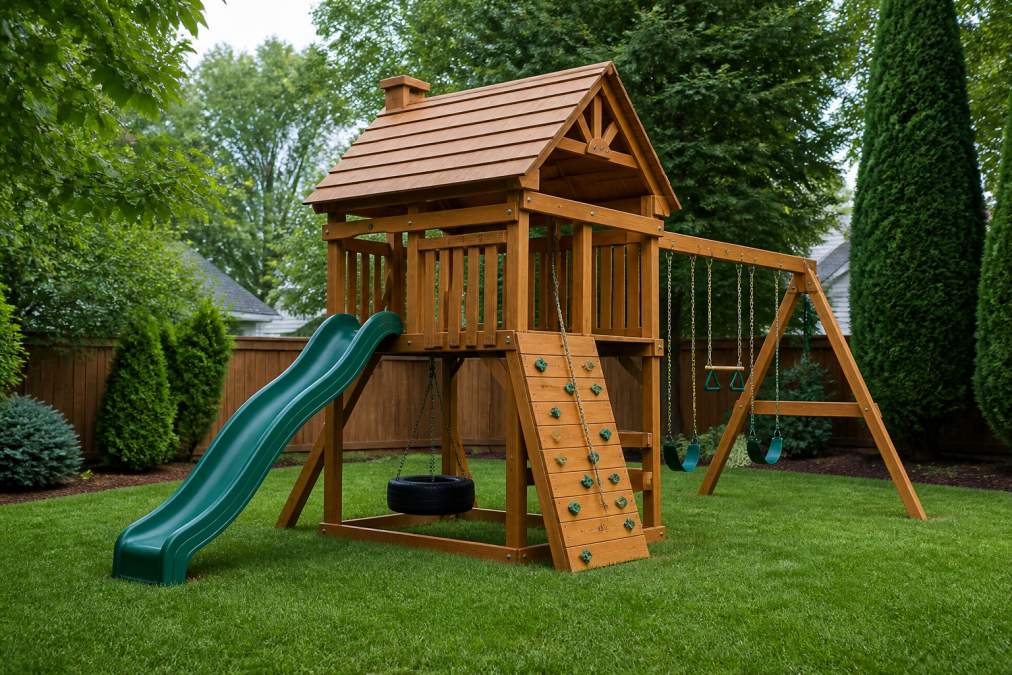
Gorilla Playsets’ Outing III demonstrates how to pack substantial play value into roughly 12 feet by 14 feet, including a clubhouse, wave slide, belt swings, and trapeze bar without sprawling across the yard.
The key is vertical stacking. Rather than spreading features horizontally, compact systems build upward. A two-story clubhouse with a slide descending from the upper level uses less ground area than a single-story structure with spread-out features.
Vertical Play Systems & Climbing Walls
Climbing walls and rope ladders add engagement without requiring horizontal space. A structure 8 feet tall but only 10 feet wide fits into small yards while offering serious play challenge.
Vertical systems work particularly well for older children and mixed-age families. Younger kids use swings and slides; older kids test themselves on climbing walls. This extends the playset’s useful lifespan across multiple children.
Backyard Playset Installation Cost & Assembly Services
The playset price is only part of the equation. Installation and assembly represent substantial hidden costs.
DIY Assembly vs. Professional Installation
A budget playset might cost $600 but require 8-10 hours of assembly. If you value your time at $25/hour, that’s another $200-$250 in labor cost. Mid-range and premium systems can demand 20-40 hours, pushing DIY labor costs into $500-$1,000.
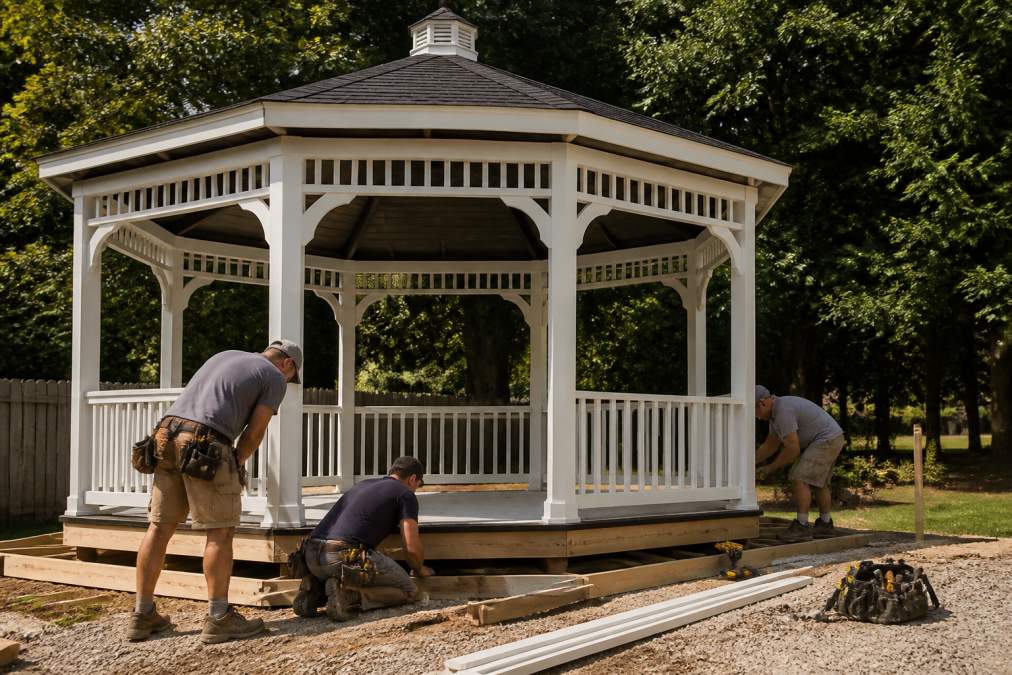
Professional installation typically costs $500-$1,200 depending on complexity. This guarantees structural integrity and saves significant time. DIY makes sense if you enjoy hands-on projects, have adequate tools, and can dedicate uninterrupted time. Assembly mistakes, incorrect bolt torque, misaligned components, improper anchoring, create safety issues that may not be obvious until failure.
If you choose DIY assembly, take photos of each step before moving to the next. Documentation helps with troubleshooting and repairs later.
Installation Difficulty Ratings & Hidden Costs
Before purchasing, search for assembly reviews or videos showing the actual process. Hidden costs include ground preparation (leveling, removing grass, installing impact surface), anchoring hardware ($100-$300), and potential modifications to existing yard features. Proper site preparation is as important as the structure itself for both safety and longevity.
Essential Playset Accessories & Customization Options
The base structure is just the starting point. Accessories transform a basic playset into a more engaging and durable system.
Swings, Slides & Climbing Features
Different swing types serve different purposes. Belt swings suit younger children; web swings and trapeze bars appeal to older kids. Slides come in variations, straight tube, wave, spiral, with wave slides appealing to younger children and tube slides challenging older kids.
Climbing features like rock walls, rope ladders, and cargo nets dramatically extend play appeal for children ages 6+ and increase engagement for mixed-age families.
Shade Solutions & Ground Anchors
Shade structures (canopies, pergolas, roof panels) extend usable playtime by reducing heat exposure. Ground anchors secure the structure against wind and enthusiastic play, preventing gradual shifting that compromises structural integrity.
Long-Term Maintenance: Keeping Your Playset Safe & Durable
A well-maintained playset lasts significantly longer than one left to weather and decay. For wooden playsets, inspect annually for soft spots, splinters, and loose bolts. Reapply sealant every 2-3 years. For steel playsets, inspect the powder coating for damage and touch up scratches promptly to prevent rust.
For all types, keep clearance zones clear of debris and low branches. Remove fallen branches promptly. Most maintenance issues are minor if caught early. Regular inspection and prompt repairs prevent most problems.
Why Choose Riehl Structures for Your Next Playset
Riehl Structures offers custom design, Amish craftsmanship, and financing that doesn’t require a second mortgage. With over 30 years in business, our family-owned approach means every playset gets personal attention. We design structures that fit your specific yard, family needs, and budget.
Our Amish builders use traditional joinery and premium materials that commercial manufacturers cut corners on. Financing options remove barriers, Rent to Own means no massive upfront payment, no home equity required, and no prepayment penalties. Free delivery within 30 miles of our West Chester and King of Prussia locations eliminates hidden shipping costs.
Choosing the right backyard playset requires balancing budget, space, maintenance tolerance, and your family’s actual play preferences. The most expensive option isn’t always the best fit, and the cheapest often becomes expensive when it requires replacement. Start with honest assessment of your priorities, then match them to a structure that delivers real value. Whether you choose a budget-friendly option to test the waters or a premium system you’ll enjoy for decades, the investment in outdoor play pays dividends in family time and childhood memories.
Frequently Asked Questions
What is the best age for children to use backyard playsets?
Most backyard playsets are designed for children ages 2-12, though specific age ranges depend on individual features. Toddler playsets (ages 2-4) focus on safety with lower heights and gentler slides. Playsets with climbing walls, rope ladders, and elevated clubhouses suit children ages 5-12. Always check manufacturer age recommendations and weight limits. Younger children may need closer supervision, while older kids can use more complex structures like web swings and rock walls.
How much space do I need for a backyard playset?
Minimum clearance varies by playset size and features. A compact wooden swing set typically requires 15×15 feet, while larger systems with multiple slides and climbing features may need 20×25 feet or more. ASTM safety standards require at least 6 feet of clear space on all sides of swings and slides. For small backyards, consider vertical play systems and compact clubhouses that maximize features without expanding the footprint. Always measure your yard and check product specifications before purchasing.
Are wooden or plastic playsets better for outdoor use?
Wooden playsets, especially cedar and redwood construction, offer durability, aesthetic appeal, and natural rot resistance, making them ideal for long-term investments. However, they require regular maintenance including staining and sealing. Plastic playsets are low-maintenance, weather-resistant, and safe for younger children, but may have shorter lifespans and can become hot in direct sunlight. Steel playsets offer extreme durability and minimal upkeep but can rust if not powder-coated. Your choice depends on budget, maintenance commitment, and intended lifespan.
What should I look for regarding playset safety guidelines?
Look for ASTM compliance, which ensures the playset meets residential playground safety standards. Verify fall protection surfaces like mulch, sand, or rubber mats beneath elevated features. Check weight limits, age appropriateness, and clearance requirements. Examine hardware for rust resistance and durability. Ensure swings have proper spacing, slides have appropriate angles, and climbing features have secure handholds. Ground anchors should be included to prevent tipping. Regular inspections for loose bolts, splintering wood, or damaged components are essential for ongoing safety.
How much does backyard playset installation cost?
Installation costs range from $0 (DIY assembly) to $500-$2,000+ for professional installation. Budget-friendly playsets like KidKraft Ainsley ($400) may take 4-6 hours to assemble yourself. Mid-range playsets require 8-12 hours of assembly effort. Premium systems often include professional installation options. Local delivery and setup services typically charge $200-$1,000 depending on complexity and location. Many manufacturers offer assembly guides, but hiring professionals ensures safety compliance and proper ground anchoring, especially for larger structures.
This article was written using GrandRanker

Copy Link