Modern Pergola Lighting for Minimalist Design Guide
Copy Link
Last Updated: November 4, 2026
Quick Summary
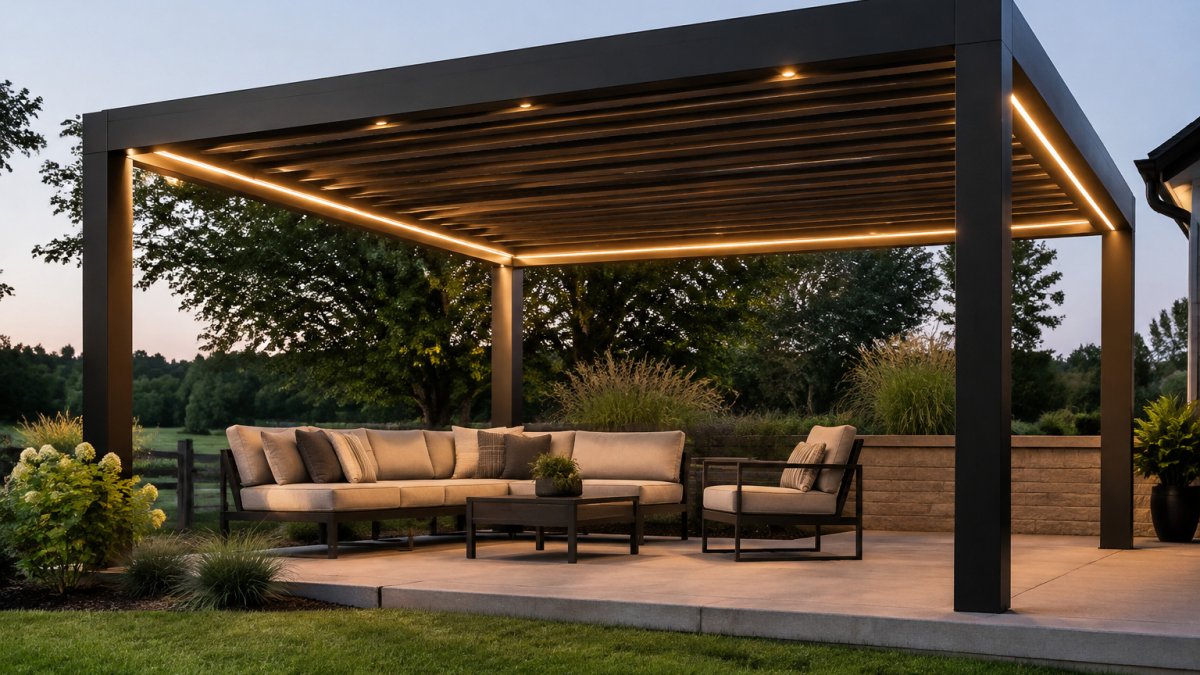
Modern pergola lighting for minimalist design works best when the light sources stay hidden in the structure. Integrated LED strips tucked into beam channels, kept warm at about 2700K to 3000K, create a clean glow with low glare.
- Mount LED strips in aluminum channels with diffusers to avoid visible bright spots.
- Choose dimmable drivers so the glow can drop low for quiet evenings.
- Keep 12-volt runs under about 50 feet and 24-volt runs under about 100 feet.
- Use IP65 or better fixtures rated for humid, freeze-thaw conditions in the West Chester area.
- Limit minimalist pergolas to one fixture family to avoid visual clutter.
Table of Contents
- Why Modern Pergola Lighting Works Best When It Disappears
- Integrated LED Strip Lighting for Clean Pergola Lines
- Choosing an Outdoor Lighting Color Temperature Guide for Evening Ambiance
- Spotlights, Pendants and Rope Lighting: Which Fixtures Suit a Minimalist Pergola
- Minimalist Outdoor Lighting Trends Shaping Pergolas Right Now
- Planning Wiring, Low-Voltage Power and Permits in West Chester
- Get a Lighting Plan Quote for Your Riehl Pergola
- Frequently Asked Questions
Why Modern Pergola Lighting Works Best When It Disappears
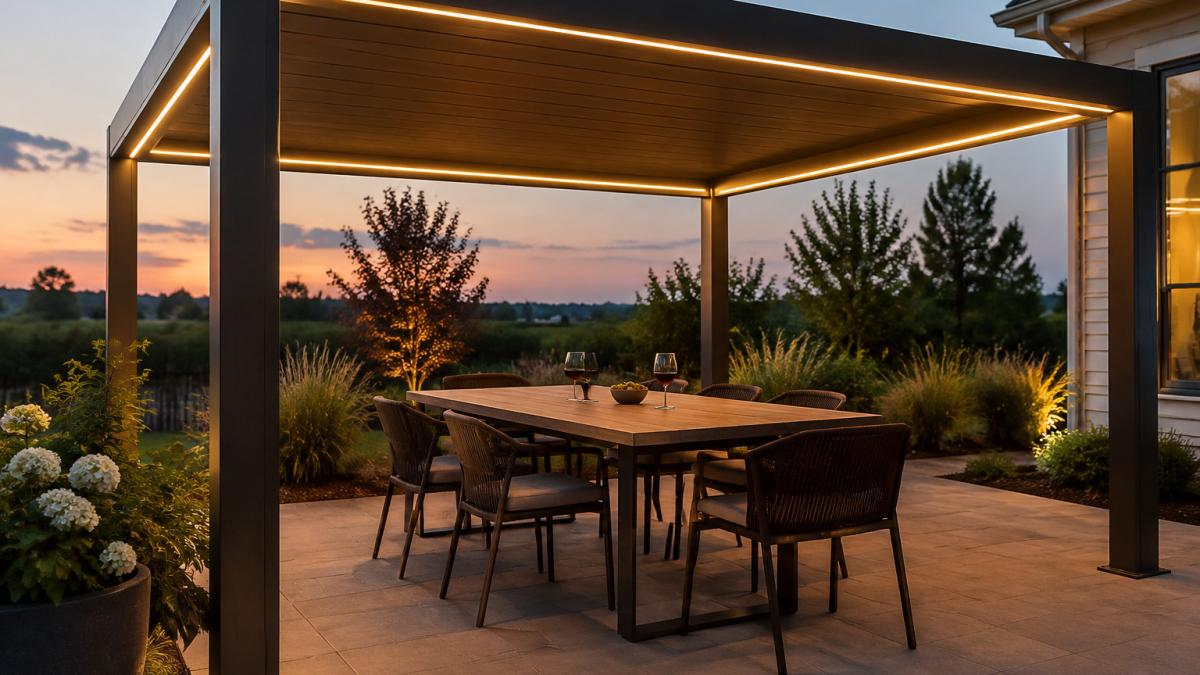
Modern pergola lighting for minimalist design is less about the fixtures you can see and more about the glow you can’t quite pin down. Designers at Riehl Structures have found that the most admired backyard pergolas hide their light sources in the structure itself. The beams and edges do the work, and the eye sees only a clean, warm outline after dark. That quiet outline becomes part of a broader conversation about modern lighting trends, where restraint lets the architecture shape the mood of an outdoor space.
Integrated lighting is also where the current design direction is heading. That single principle shapes most of the decisions below.
Two design goals run through this guide. The first is keeping lines clean, so fixtures don’t break the geometry of the roof and posts. The second is creating evening ambiance that makes the space feel finished. Pergola lighting ideas that serve both goals tend to share three traits: concealed sources, low glare, and warm color temperature. Keep those three in mind as you read.
Integrated LED Strip Lighting for Clean Pergola Lines
Integrated LED strips are the most direct route to minimalist pergola lighting. Browse pergola lighting ideas for backyard to see how these layouts look in finished spaces. Tuck low-voltage strips into a channel along the underside of the beams, and the light grazes the structure without any visible hardware.
Planning details matter more than people expect:
- Mount strips in aluminum channels with diffusers to avoid visible bright spots.
- Run wiring inside the beams where possible, so no cords cross the ceiling plane.
- Choose dimmable drivers so the glow can drop low for quiet evenings.
A common mistake is installing strips too bright. Start at a lower brightness than you think you need. You can always raise it, but glare is hard to undo once the fixtures are set.
Choosing an Outdoor Lighting Color Temperature Guide for Evening Ambiance
Color temperature shapes how an outdoor space feels after dark more than almost any other choice. Warm white, in the range of about 2700K to 3000K, tends to feel inviting and suits dining areas. Read the waterproof pergola lighting for all seasons article for damp-rated options that hold up through every season. Cooler tones can look crisp but often feel clinical under a pergola roof, so most minimalist designs lean warm.
This is the part of the outdoor lighting color temperature guide most buyers skip. Test a sample strip at night before committing, since the same fixture can look amber on a deck and stark against pale stone. Pay particular attention to how the light reflects off the pergola’s finish. Dark charcoal aluminum absorbs more light than white or warm earth tones, so it may need a slightly brighter setting to achieve the same effect.
Keep one color temperature across the whole structure. Mixing warm and cool fixtures under the same roof creates visual noise that undermines the clean look you’re after.
Spotlights, Pendants and Rope Lighting: Which Fixtures Suit a Minimalist Pergola
Not every fixture type belongs under a minimalist roof. Spotlights, pendants and rope lighting each solve a different problem, and choosing well depends on what the space is for and how much visual noise you are willing to accept.
Recessed and flush spotlights are the workhorses of a minimalist pergola. Mount them flush or recessed into the beams and aim them at a cooking zone, dining surface or walkway. Review how to build a pergola to understand the frame and beam layout before choosing where each spot mounts. The key numbers: a narrow beam spread of about 15 to 25 degrees keeps light on the task and off the beams, while a wider 35 to 45 degree spread washes a wall or floor. Choose fixtures with a deep regress or honeycomb baffle so the source stays hidden from seated eye level.
Pendants add a decorative focal point over a table, but they interrupt clean sightlines if oversized. For a minimalist look, choose slim cylindrical or linear profiles in matte black or warm metal, hang them 30 to 36 inches above the tabletop, and use a single row rather than a cluster. A pendant is the one place where a visible fixture is acceptable, so treat it as jewelry, not as the main light source.
Rope lighting works well for outlining the perimeter of a pergola because it reads as a soft line rather than a set of points. The trade-off is that rope lighting is less controllable than strip lighting: it is harder to dim smoothly and harder to conceal in a channel with a diffuser. Use it for a continuous outline along the fascia or beam edge, not for task light.
For a truly minimalist look, limit yourself to one fixture family per structure. Mixing all three usually produces clutter. If you need task light and ambiance, pair concealed strips for ambiance with one or two recessed spots for work. Watch out: pendant fixtures hung too low or too large in diameter become the dominant visual element and undo the clean geometry the rest of the design is working toward.
Minimalist Outdoor Lighting Trends Shaping Pergolas Right Now
The strongest trend in 2026 is what designers call the sleek perimeter glow. Instead of lighting the middle of the space, fixtures outline the roof edges and beams, leaving the center comfortably dim.
Homeowners are also choosing low-voltage LED systems and integrated lighting within motorized louvered roofs.
The material palette reinforces the look. Aluminum in dark charcoal, black or warm earth tones dominates current designs, and lighting is often chosen to complement those finishes rather than contrast with them.
Planning Wiring, Low-Voltage Power and Permits in West Chester
Before any fixture goes up, plan the power. Low-voltage LED systems are typically the simplest route for a pergola because they reduce shock risk and make integration easier, but the transformer, the wire runs and the connection to your home’s circuit all need to be planned together. This is the section most lighting guides skip, and it is where a West Chester installation either goes smoothly or turns into a rework.
Voltage drop and wire sizing. Low-voltage runs lose brightness over distance. A common pattern is to keep 12-volt runs under about 50 feet and 24-volt runs under about 100 feet before voltage drop becomes visible as dimming at the far end. If your pergola is large, plan multiple home runs back to the transformer rather than daisy-chaining every strip. Size the transformer with roughly 20 percent headroom above the connected load so it runs cool and has room for a dimmer.
GFCI and weather protection. Outdoor circuits in the United States are generally required to have ground-fault circuit-interrupter protection. In practice, that means the receptacle feeding the transformer should be a GFCI receptacle or on a GFCI breaker, and all connections should be in weatherproof enclosures rated for wet locations. Look for fixtures and drivers marked for wet or damp locations, not just ‘outdoor.’
West Chester and southeastern Pennsylvania climate. This region brings humid summers, freeze-thaw winters and driving rain, so specify fixtures with IP65 or better ratings, stainless or powder-coated hardware, and drivers rated for the temperature swing. Bury or protect low-voltage cable in conduit where it crosses grade, and leave service loops at connections so the cable is not under tension when the ground moves. Snow load and ice on the pergola roof are also worth discussing with your installer, since fixtures mounted on top of beams can be crushed or pulled loose.
Permits and inspections. Whether your project needs a permit depends on how the pergola is attached, its size, and how much new wiring you add. In Pennsylvania, electrical work is generally permitted and inspected at the municipal level, and Ask three questions before you buy fixtures: Does the structure itself need a building permit? Does the new circuit need an electrical permit? And which inspections apply? A licensed electrician can confirm current requirements and pull the permit if one is needed. Check the Chester County shed permit requirements guide to see whether your project triggers zoning or building approval.
Riehl Structures is a local, family-owned business serving West Chester and King of Prussia.
Watch out: skipping the permit step to save time can surface at resale or after a storm, when an unpermitted circuit becomes an insurance and inspection problem.
The article sums up the key wiring and power limits a West Chester installation has to respect:
| Item | Value | Note |
|---|---|---|
| 12-volt run length | Under about 50 feet | Beyond this, far-end dimming becomes visible |
| 24-volt run length | Under about 100 feet | Beyond this, voltage drop shows up |
| Transformer headroom | About 20 percent | Above the connected load |
| Fixture rating | IP65 or better | Suited to humid, freeze-thaw, wet conditions |
| Outdoor circuit protection | GFCI | Receptacle or breaker for the transformer |
| Climate concern | Snow and ice loads | Can crush or pull loose top-mounted fixtures |
Get a Lighting Plan Quote for Your Riehl Pergola
A well-lit pergola should feel like part of the house, not an add-on. Explore outdoor furniture that complements a finished pergola before you request your quote. The principles here (concealed sources, warm color, low glare and careful wiring) give you a clear starting point for a minimalist design that works after dark. Pricing depends on the size of the structure, the number of runs and the fixtures you choose, so the most accurate next step is to request a quote for your specific space. Get a quote now and let the team at Riehl Structures help you plan a lighting layout that disappears into the frame.
Frequently Asked Questions
What are the best lighting options for a minimalist pergola?
For a minimalist pergola, integrated LED strips tucked into beam edges or louver channels give clean, architectural light without visible fixtures. Dimmable low-voltage LED fixtures add flexibility for dining and task areas, while subtle spotlights can accent a column or planter. Rope lighting works well along perimeter edges for a soft glow. Pricing varies with length, fixture count and installation, so request a quote from Riehl Structures for current costs before you commit to a layout.
What color temperature is best for modern outdoor lighting?
Warm white in the 2700K to 3000K range is the most common choice for pergola and patio lighting because it feels inviting and matches the warm finishes popular in modern designs. Cooler 4000K light can suit a contemporary, crisp look or task areas like grill zones, but it can feel harsh in an evening setting. Many homeowners pick warm white for seating areas and reserve brighter neutral light for cooking spaces.
Can you integrate LED strips into a custom pergola design?
Yes. Integrated LED strips are typically routed into a channel along beam undersides, rafter edges or louver housings, so the light source stays hidden while the glow shows. Planning the channel and power path before the structure is built makes the installation cleaner.
What are the benefits of low-voltage lighting for outdoor structures?
Low-voltage lighting runs on a transformer at a safer voltage, which simplifies installation and reduces shock risk compared with standard line-voltage wiring. It also works well with LED fixtures, which use less energy and generally last longer. Because low-voltage runs can be concealed in beams and edges, the result suits minimalist designs. Local electrical codes and permit requirements still apply, so confirm the details with your township before installation.


Copy Link